Sunday, June 7, 2015

Sermon for First Sunday after Trinity - Lk 16:19-31


                                                                                    Trinity 1
                                                                                    Lk 16:19-21
                                                                                    6/7/15

            In 1989 the movie “Back to the Future 2” appeared in theaters.  It continued the story of the immensely successful 1985 movie by the same name that had starred Michael J. Fox as Marty McFly.  In the first movie, McFly had travelled back in time thirty years to 1955 using a time machine built by his friend Doc Brown.  There after accidentally interfering with the event in which his parents fell in love, he had to make sure that they did become a couple in spite of interference by his father’s antagonist Biff, so that Marty could one day be born.
            At the end of the movie, Marty returns to his present day of 1985 and finds that his actions in 1955 have altered his present for the better.  However in the very last scene Doc Brown appears in the time machine to tell Marty that they most go to the future to address a problem that has developed in Marty’s family.
            In “Back to the Future 2” Marty and Doc Brown travel thirty years into the future – to the year 2015.  Now in 1989, 2015 sounded a long ways away.  Now that we are here, this date in the movie just makes me feel old.  And of course the future depicted in the movie isn’t exactly the way things have turned out – we are still waiting for those hoverboards. 
            The rest of the movie’s plot is highly convoluted – and with apologies to my children, not very good - but it revolves around a basic fact.  Marty’s family has fallen into financial ruin while Biff’s family is now incredibly rich.  Marty buys a sports almanac that has the outcomes of sporting events from 1950 to 2000 intending to use it to make money when he goes back in time.  However, Doc Brown catches him and makes Marty throw it away.  Instead Biff finds the almanac and then uses the time machine to go back to 1955 and give it to himself.  The sports almanac turns out to be the way Biff makes his fortune by betting on sporting events whose outcome he already knows.
            Think of the wealth you could acquire and the lifestyle you could lead if you could go back in time with the knowledge you possess today.  What if you could go back to 1976 and be there to provide venture capital to two guys named Steve Jobs and Steve Wozniak who were starting a little computer company called Apple.  There is almost no limit to how much money you could make.  And there would be no limit to the lifestyle you could lead.
            That last statement describes the rich man in our Lord’s parable today. There was no limit to his lifestyle and he chose to enjoy that fact to the full.  Jesus says, “There was a rich man who was clothed in purple and fine linen and who feasted sumptuously every day.”  This was the picture of absurdity – he was using hundred dollar bills to light his Cuban cigars.  Here was the use of wealth unhinged from reality.
            The contrast of Lazarus with the rich man could not be more stark.  We are told, “And at his gate was laid a poor man named Lazarus, covered with sores, who desired to be fed with what fell from the rich man's table. Moreover, even the dogs came and licked his sores.”  Destitute and sick, Lazarus was a pathetic figure.
            Luke’s Gospel often develops the theme of the great reversal.  In the very first chapter, Mary said in the Magnificat, “he has brought down the mighty from their thrones
and exalted those of humble estate; he has filled the hungry with good things, and the rich he has sent away empty.”  And here in our text we see a prime example of this in death.
            Lazarus dies and is carried by the angels to Abraham’s side, while the rich man finds himself in torment in Hades.  This fact is a shock … and it would have been a tremendous shock to some of the people who were listening.  Jesus has just said, “No servant can serve two masters, for either he will hate the one and love the other, or he will be devoted to the one and despise the other. You cannot serve God and money.” And then Luke tells us, “The Pharisees, who were lovers of money, heard all these things, and they ridiculed him.”
            The Pharisees reflected the prevailing view of the day.  They came from the Joel Osteen school of theology and believed that wealth was a sure sign of a right standing with God because God wants to bless you if you are just faithful.  On the other hand, poverty was a sure sign of God’s disfavor, and clearly you the person had deserved that as well. And so when Jesus spoke about wealth as a spiritual hindrance, the Pharisees mocked Jesus.
            In the parable the rich man learns that there is nothing that can help him.  And so he asks Abraham to send Lazarus back to warn his five brothers.  Yet Abraham refuses and says, “They have Moses and the Prophets; let them hear them.” The rich man pleads, “No, father Abraham, but if someone goes to them from the dead, they will repent.” And with finality Abraham answers, “If they do not hear Moses and the Prophets, neither will they be convinced if someone should rise from the dead.”
            Now if you have been in the Church for any amount of time, the parable of the rich man and Lazarus is no doubt familiar to you.  But the reality is that when we think about this parable we usually go looking for meaning in the wrong places.  We are fascinated with questions about what things are like between death and the return of Christ.  And so we are drawn to the description in this parable.  Yet it is a parable – a story.  It draws upon stock images and ideas that were present in first century Judaism in describing the dead.  And besides that is not Jesus’ focus.  Instead he is always talking about his return to raise the dead and judge.
            The last statement in the text - “If they do not hear Moses and the Prophets, neither will they be convinced if someone should rise from the dead.” – has provided the basis for many sermons. A message about the power and adequacy of God’s Word is certainly true to this text – I’ve preached it that way from this pulpit in years past.
            But the main point here – the thing that is the true focus of the parable – is something we often miss. And to be honest, we want to miss it.  It involves a difficult spiritual truth we don’t want to confront.
            The clue about this is found in the rich man’s hope that his five brothers will repent.  He wants his brothers to do something that he himself did not do.  Up to this point, the only thing we have been told is that the rich man lived an absurdly rich lifestyle and went to Hades, while Lazarus lived an absurdly destitute life and received salvation.
            The language of repentance tells us that this is about more than just a reversal of fortune.  It becomes clear that in the way the rich man used his wealth, he sinned.  He is an illustration of what Jesus has just said: “No servant can serve two masters, for either he will hate the one and love the other, or he will be devoted to the one and despise the other. You cannot serve God and money.”  While Lazarus lies at the gate of his house, the rich man serves himself with his money. And at the same time, Lazarus is an illustration of faithful trust in God.
            The use of wealth and the way this interacts with faith is an important theme in Luke and Acts.  It’s a theme you and I really don’t want to hear.  Because you see, we want to be the rich man in the parable.  We want to have wealth and we want to use it to give ourselves pleasure and enjoyment.  And we don’t want to use it to help others if this in any way impinges on our ability to have the full enjoyment we think we deserve.  Oh sure, we’ll help some – we’ll give our offering at church; we’ll give a little to some other ministries and charities – but we aren’t going to do anything that fundamentally changes our own comfort level.  And when you deal with wealth that way … well, there is your god.
            I’ll bet my last dollar that this is true of every single person here this morning – well maybe not yet the babies Aubrey  and Elliot.  But it won’t be long for them either.  Living in the western world of affluence, it is part of the air we breath.
            This morning, Jesus calls us on it. He confronts us with the fact that we serve wealth as our god.  He shows us that spiritually we are Lazarus – destitute and covered with oozing sores.  On our own we are helpless and cut off from God.
            But the good news is the Good News – the Gospel.  Jesus said, “I have not come to call the righteous but sinners to repentance.”  He told the disciples after his resurrection that repentance and forgiveness of sins should be proclaimed in his name to all nations, beginning from Jerusalem.  Jesus Christ died on the cross because you make wealth your God.  He died for you because you break the First Commandment in this way.  And by his resurrection from the dead he defeated the death that sin produces.
            He has freed you from sin through this forgiveness.  He has lifted you up, so that now as a baptized child of God you already know that salvation is yours. You live as someone who doesn’t belong lying at the gate, but instead dining in the big house.  In fact you will receive a foretaste of that feast in a few minutes.
            This is what Christ has done for you. The apostle Paul put it this way when talking about the topic if money, “For you know the grace of our Lord Jesus Christ, that though he was rich, yet for your sake he became poor, so that you by his poverty might become rich.”
            But it doesn’t stop there – it can’t stop there.  Instead the Gospel of Jesus Christ prompts us to do things through the work of the Spirit.  We begin to see money and wealth in a new way.  We recognize it as an asset that can be used for service rather than something we cling to so that it can serve us.  And we also begin to deal with it in a new way.  We begin to return more of it to God for the work of Gospel in this place and around the world.  We begin to use more of it to assist other Christians in need.  We begin to use more of it to help our neighbor who is in need.
            We are fallen people who still must struggle against the old Adam within us.  And so as the new man within us is nourished by the Means of Grace, this is probably not a change that we make in one giant leap.  Realistically, it is probably something best accomplished in a continuing series of small steps – one grace filled step after another by which we live more and more as what Christ has made us to be.            


Friday, June 5, 2015

Interview on Issues, Etc.: Why Early Christians Worshipped Before Sunrise

Today I did an interview with Todd Wilken on Issues, Etc. about why Christians during the first three hundred years of the Church worshipped on Sunday before sunrise.  Their experience speaks to our present and future was we live in an increasingly post-Christian world.

Commemoration of Boniface of Mainz, Missionary to the Germans


Today we remember and give thanks for Boniface of Mainz, Missionary to the Germans. Boniface was born in the late seventh century in England. He became a monk, and was ordained as a presbyter in England, where he was inspired by the example of others to become a missionary. Upon receiving a papal commission in 719 to work in Germany, Boniface devoted himself to planting, organizing, and reforming churches and monasteries in Hesse, Thuringia, and Bavaria. After becoming an archbishop, Boniface was assigned to the See of Mainz in 743. Ten years later he resigned his position to engage in mission work in the Netherlands. On June 5, 754, while awaiting a group of converts for confirmation, Boniface and his companions were murdered by a band of pagans. Boniface is known as the apostle and missionary to the Germans.

Collect of the Day:
Almighty God, You called Boniface to be a witness and martyr in Germany, and by his labor and suffering You raised up a people for Your own possession. Pour out Your Holy Spirit upon Your Church in every land, that by the service and sacrifice of many Your holy name may be glorified and Your kingdom enlarged; through Jesus Christ, our Lord, who lives and reigns with You and the Holy Spirit, one God, now and forever.


Thursday, May 28, 2015

200,000 pageviews - Thank you for reading and sharing


Today Surburg's blog reached 200,000 pageviews.  I want to thank everyone who has read and shared the blog since the first post on Feb. 4, 2013.  In a way that I never could have imagined, this has become a means to share material with others in the hopes it will be of use to them.  I want to thank my wife Amy and my parents Paul and Ellen who strongly encouraged me to start a blog: You were right.  

Tuesday, May 26, 2015

Mark's thoughts: They worshipped when?!?


During the years 111-113 A.D. a Roman named Pliny served as the appointed governor over the area Pontus-Bythinia in what is today Turkey.  Although communication was by our standards painfully slow, governors like Pliny constantly consulted the Roman emperor by letter and asked for his decisions and judgments on matters.  A large part of the job of a Roman emperor was to answer this endless correspondence that came in from all over the empire. 

In Pontus-Bythinia Pliny encountered a group that prompted him to write to the Emperor Trajan.  They were called “Christians” and Pliny was not exactly sure how to deal with them.  In writing his letter Pliny provided the following description:

They asserted, however, that the sum and substance of their fault or error had been that they were accustomed to meet on a fixed day before dawn and sing responsively a hymn to Christ as to a god, and to bind themselves by oath, not to some crime, but not to commit fraud, theft, or adultery, not falsify their trust, nor to refuse to return a trust when   called upon to do so. When this was over, it was their custom to depart and to assemble again to partake of food--but ordinary and innocent food. Even this, they affirmed, they had ceased to do after my edict by which, in accordance with your instructions, I had forbidden political associations. Accordingly, I judged it all the more necessary to find out what the truth was by torturing two female slaves who were called deaconesses. But I discovered nothing else but depraved, excessive superstition. (Letters 10.96-97)


Pliny provides us with a very early description of Christian practice.  He says that the Christians were “accustomed to meet on a fixed day before dawn.”  From the New Testament and other early Christian evidence, we know that this day was Sunday.  What we want to note here is that they met “before dawn.”  Pliny says that they also used to meet in the evening of Sunday, but had ceased to do this since on Trajan’s instruction Pliny had placed great restrictions on all of these kinds of gatherings out of fear they might provide the setting for political agitation.


About fifty years later a Christian named Justin Martyr wrote a defense of Christianity to the Roman emperor.  He provided a description of Christian worship (the earliest that we have) and reported:


On the day named after the sun, all who live in city or countryside assemble. The memoirs of the apostles or the writings of the prophets are read for a long as time allows … It is on Sunday that we all assemble, because Sunday is the first day: the day on which God transformed darkness and matter and created the world, and the day on which Jesus Christ our Savior rose from the dead.  He was crucified on the eve of Saturn’s day, and on the day after, that is, on the day of the sun, he appeared to his apostles and disciples and taught them what we have now offered for your examination (Apology I, 67).


Pliny tells us that the Christians of the second century gathered on a fixed day before dawn and Justin Martyr tells us that Christians gathered on Sunday and listened to the reading of the Scriptures “as long as time allows.”  Because of our own experience of life in the Church, it is not immediately apparent why they gathered before dawn and had limitations on how long the service could go. 


The reason for this was that Sunday was a regular work day.  As Justin describes, because Sunday was when Christ rose from the dead, Christians worshipped in the morning on the first day of the week when the resurrection was made known (Matthew 28:1).  Yet this theologically motivated choice ran headlong into a practical reality: Sunday was a work day in the ancient world.  In order to worship on Sunday morning, it was necessary to celebrate the Divine Service before going to work.  Sunday for a second century Christian meant getting up before dawn, attending worship, and then going on to a full day of work.


In 313 A.D. the Emperor Constantine acted to end the persecution of Christians.  In his own growing commitment to Christ he took actions that favored the Church but which could also be understood by pagans as honoring their beliefs.  He passed laws that paid homage to Sunday and could be seen as honoring Christ and honoring the sun god.  The first law passed in March 321 said that: “All judges and the people of the towns and all craftsmen are to remain at rest on the venerable day of the sun.”  Only agricultural work could be exempted from this in order to take advantage of the weather.  In this way, Sunday became a day when no work was done, so that Christians were free to worship with ease.


The practice of Christians before the legalization of Christianity and the promulgation of Constantine’s laws prompts us to reflect upon our own attitude toward Sunday and the Divine Service.  In the Small Catechism the explanation to the Third Commandment says: “We should fear and love God so that we do not despise preaching and his word, but hold it sacred and gladly hear and learn it.”  Would we be willing to get up before dawn in order to attend the Divine Service and then head off to a day of work? Do we consider the Lord Jesus and his Means of Grace so precious that we are willing to put them before other things in life?


 Jesus said: “If anyone would come after me, let him deny himself and take up his cross and follow me. For whoever would save his life will lose it, but whoever loses his life for my sake will find it” (Matthew 16:24-25 ESV).  As the era of the post-Christian world continues to advance in our culture, we are encountering more and more situations that reflect the experience of our early Christian forefathers.  Sporting events, school activities and a growing list of other endeavors are scheduled for Sunday morning.  The faithful practice of the Christian faith will require an ever greater commitment.


 It will require sacrifice in order put Jesus Christ first as the Lord of our life.  The saints who have gone before provide both a model and an encouragement.  They show us what Christians have done in order to be faithful, and they demonstrate how by his grace God enabled them to do this.  On Feb. 12, 304 thirty one men and eighteen women were arrested for illegal assembly during the Great Persecution of Emperor Diocletian.  They appeared before the Roman proconsul in Carthage who accused them of disobeying the imperial edicts. In the trial that occurred before they were killed as martyrs, Emeritus, a lector confessed that he had been involved in Christian worship and that it had been held in his house. He said, “Yes, it was in my house that we celebrated the Lord’s Day.  We cannot live without celebrating the Lord’s Day” (Bibliographia hagiographica Latina, no. 7492).


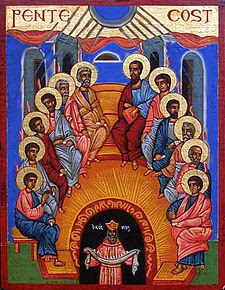
Pentecost Tuesday


During the octave (the eight days) in which we celebrate the Feast of Pentecost, today is Pentecost Tuesday.  We continue to rejoice in the gift of the Holy Spirit, whom Christ poured out upon the Church on Pentecost.  The text for today tells of how the Spirit dramatically showed that the Gospel was to be preached to non-Jews in Palestine - the Samaritans.

Scripture reading:
Now when the apostles at Jerusalem heard that Samaria had received the word of God, they sent to them Peter and John, who came down and prayed for them that they might receive the Holy Spirit, for he had not yet fallen on any of them, but they had only been baptized in the name of the Lord Jesus. Then they laid their hands on them and they received the Holy Spirit (Acts 8:14-17).

Collect of the Day:
Almighty and ever-living God, You fulfilled Your promise by sending the gift of the Holy Spirit to unite the disciples of all nations in the cross and resurrection of Your Son, Jesus Christ.  By the preaching of the Gospel spread this gift to the ends of the earth; through the same Jesus Christ, our Lord, who lives and reigns with You and the Holy Spirit, one God, now and forever.