Wednesday, May 11, 2022

Commemoration of Cyril and Methodius, Missionaries to the Slavs


Today we remember and give thanks for Cyril and Methodius, Missionaries to the Slavs.  Cyril   (826-69) and Methodius (c. 815-85) were brothers who came from a Greek family in Thessalonica. The younger brother took the name "Cyril" when he became a monk in 868. After ordination, Cyril became librarian at the church of Holy Wisdom (Hagia Sophia) in Constantinople. In 862 the brothers were sent by the emperor as missionaries to what is now the Czech republic, where they taught in the native Slavic tongue. Cyril invented the alphabet today know today as "Cyrillic," which provided a written language for the liturgy and Scriptures for the Slavic peoples. This use of the vernacular established an important principle for evangelical missions.

Collect of the Day:

Almighty and everlasting God, we thank you for your servants Cyril and Methodius, whom you called to preach the Gospel to the Slavic peoples. Raise up in this and every land evangelists and heralds of your kingdom, that your Church may proclaim the unsearchable riches of our Savior Jesus Christ, who lives and reigns with you and the Holy Spirit, one God now and forever.


(Treasury of Daily Prayer, 1296-1297)


Thursday, May 5, 2022

Commemoration of Fredrick the Wise, Christian Ruler


Today we remember and give thanks for Frederick the Wise, Christian Ruler.  Frederick the Wise, elector of Saxony from 1486 to 1525, was Martin Luther's sovereign in the early years of the Reformation. Were it not for Frederick, there might not have been a Lutheran Reformation. Born in Torgau in 1463, he became so well known for his skill in political diplomacy and his sense of justice and fairness that he was called "the Wise" by his subjects. Though he never met Luther, Frederick repeatedly protected and provided for him. In all likelihood he saved the reformer from a martyr's fate. Frederick refused the pope's demand to extradite Luther to Rome for a heresy trial in 1518. When Emperor Charles V declared Luther an outlaw in 1521 at the Diet of Worms, Frederick provided sanctuary for Luther at the Wartburg castle. On his deathbed, Frederick received the Lord's Supper in both kinds--a clear confession of the evangelical faith.


Collect of the Day:

Together with Fredrick and all your saints who now rest from their labors, we look forward to your future coming to usher in your new creation--a place free from sin and death, a place where all our voices will praise You without end for Your great glory. Until that appointed time, continue to sustain us in this certain hope throughout all our earthly days; through Jesus Christ, our Lord, who lives and reigns with You and the Holy Spirit, one God, now and forever.


(Treasury of Daily Prayer, pg. 1294-1295).


Sunday, May 1, 2022

Sermon for the Feast of St. Philip and St. James - Jn 14:1-14


St. Philip and St. James

                                                                Jn 14:1-14

                                                                5/1/22


          If you were going to have a day when you celebrated the career and service to our country provided by General Douglas MacArthur, what events would you choose to highlight?  Would you talk about that fact while serving in World War I as an officer he was awarded seven Silver Stars and the Distinguished Service Cross, and that he for a second time he was nominated for the Congressional Medal of Honor?  Would you talk about the remarkable leadership he provided in defeating the Japanese during World War II?  Would you talk about the brilliant amphibious landing at Inchon, Korea that MacArthur planned, and how it forced the North Koreans to retreat rapidly from South Korea?

          Or would you talk about how despite knowing about the attack on Pearl Harbor, MacArthur left his air force in the Philippines on the ground and allowed it to be decimated by Japanese air raids?  Would you talk about how on the orders of President Roosevelt, MacArthur left his forces in the Philipines to face defeat, the Bataan death march and years in the terrible conditions of being prisoners of war at the hands of the Japanese? Would you talk about how MacArthur did not truly believe the Chinese were a threat in the Korean War, which led to terrible defeats when they attacked, and ultimately led to MacArthur being removed from command by President Truman?

          It seems safe to say that you would focus on the first group of events.  After all the purpose of the day would be to celebrate General MacArthur and not to make him look bad.  Bearing this in mind, the selection of the Gospel reading for the Feast of St. Philip and St. James seems rather odd. It is a text that frankly, doesn’t make Philip look very good.  There are texts in John’s Gospel that show him doing good things. But while this text doesn’t depict Philip in one of his more shining moments, it does contain key truths that Philip, James and the other apostles learned from our Lord and have passed on to us.

          Today is the Feast of St. Philip and St. James.  Now for starters, let me tell you what we know about James.  He was an apostle of Jesus Christ.  He was the son of Alphaeus. That’s it. That’s all Scripture says.  Of course, there was another James, the brother of John, who was an apostle.  We learn a great deal about him since he was in the inner circle of Peter, James and John whom our Lord took with him on several important occasions including his transfiguration and the time in the Garden of Gethsemane.  That James was the first apostle martyred for confessing Jesus Christ as Lord. In order to distinguish them, today’s James is called “the younger” or perhaps more aptly, “the less.”  James the less, not exactly the designation you would choose for yourself.

          However, James was an apostle of Jesus Christ. This means that out of all the disciples who followed Jesus, he was one of twelve chosen by Jesus to play a unique role. Matthew tells us that Jesus sent James and the apostles out to preach.  He commanded them: “Heal the sick, raise the dead, cleanse lepers, cast out demons.” This is what James did.

          James and Philip were apostles. That means they were the authorized representatives of Jesus Christ.  They received his teaching. They witnessed his miracles.  Most importantly they were witnesses to the resurrection of Jesus Christ who had been crucified and buried.  For forty days they were with the risen Lord and were taught by him. 

The existence of the apostles was a one time event, because by definition they were those who were with Jesus during his earthly ministry and resurrection until his ascension.  It is their witness that we receive through the Gospels.  It is their authoritative teaching – that we receive in the New Testament.  It is through their word that Jesus Christ calls us to faith and teaches us what to believe. We confess the apostolic Church, because through the apostles God has given us the revelation of Jesus Christ.

Last Sunday I mentioned that John’s Gospel contains three chapters that tell us about what Jesus said on the way to the Garden of Gethsemane.  Our text today is the beginning of this, and right from the start we learn that Jesus will be leaving. He says, “Let not your hearts be troubled. Believe in God; believe also in me. In my Father's house are many rooms. If it were not so, would I have told you that I go to prepare a place for you? And if I go and prepare a place for you, I will come again and will take you to myself, that where I am you may be also.”

Our Lord told the disciples not to be troubled.  He called them to faith in God and to faith in him.  He said he was going away but promised that he would return. While we are fascinated by the language of a house with rooms, the really important point is when Jesus says, “I will come again and will take you to myself, that where I am you may be also.”  Our Lord said that he would take them to himself.  Where Jesus was, there they would be also – they would be with Jesus.

Then Jesus added, “And you know the way to where I am going.” Thomas was completely puzzled by this. He said, “Lord, we do not know where you are going. How can we know the way?” Then Jesus responded with well known words that reveal the destination is not a place.  Instead it is God himself.  And the way is not the route on a map, but a person – the person of Jesus Christ. Jesus said to him, “I am the way, and the truth, and the life. No one comes to the Father except through me.  If you had known me, you would have known my Father also. From now on you do know him and have seen him.”

Jesus alone is the way to the Father because he is the Lamb of God who has taken away the sin of the world by his death on the cross and resurrection from the dead.  John tells us in the first chapter of the Gospel that Jesus Christ is the Word become flesh – he is the incarnate Son of God. Then he adds, “No one has ever seen God; the only God, who is at the Father's side, he has made him known.”  It is God the Son who has revealed the Father by carrying out the saving work of the Father’s will for us.

Our Lord said that to know him was to know the Father.  To see Jesus was to see the Father.  And then our man Philip responded: “Lord, show us the Father, and it is enough for us." Jesus answered him: “Have I been with you so long, and you still do not know me, Philip? Whoever has seen me has seen the Father. How can you say, ‘Show us the Father’? Do you not believe that I am in the Father and the Father is in me? The words that I say to you I do not speak on my own authority, but the Father who dwells in me does his works.”

          Philip wanted something beyond Jesus.  He wanted something more direct.  Martin Luther identified Philip’s statement as a classic example of the theology of glory.  And we are no different from Philip, because the theology of glory is the temptation that dwells in all of us because of the fallen nature. We want God to act in ways by which he directly reveal himself.  We want to him act in ways that reveal success and power.  That’s what we want to see in the Church. That’s what we want to see in our lives.  

          Have you noticed how no losing coach or player being interviewed after a game ever begins his statement by saying, “First, I want to thank my Lord and Savior Jesus Christ for making this possible.”  Winning coaches and players often say things like this in interviews. We view these statements as being very positive witnesses to the faith.  But why is it that no one says this when they lose and fail?  The reason is that we don’t view loss and failure as examples of God being at work.  We define God’s work as glory, power, and success. That’s what we want to see.

          Philip didn’t recognize that in Jesus, he was seeing the Father.  He was hearing the Father’s words.  He was seeing the Father at work.  He didn’t because God was doing it in a hidden way.  In a way that required faith to be perceived.

          Jesus was man. He was, of course, more than just a man - he was God in the flesh.  But God was present through the located means of the flesh of Jesus.  That didn’t look glorious. Certainly, Jesus performed miracles.  But you know what else happened?  Jesus met with rejection and opposition. The Jewish religious leaders – those who had the power – rejected him.

          That opposition and power directed against Jesus culminated in the events we just remembered during Holy Week.  Jesus ended up as a man dying on the cross. The crucified Christ did not look like the revelation of the Father.  It did not look like God acting in a mighty way.  It did not in any way look like success.

          During Holy Week Jesus said, “The hour has come for the Son of Man to be glorified. Truly, truly, I say to you, unless a grain of wheat falls into the earth and dies, it remains alone; but if it dies, it bears much fruit.”  Jesus described his death as his glorification.  He did so because it was in this way that he rescued us from sin and the devil.  He did so because as we celebrate during this Easter season, he did not stay dead.  Instead, on the third day Jesus rose from the dead and defeated death.  He did so because the risen and exalted Lord returned to the Father in his ascension, just as he said he would.

          It is because of the death and resurrection of Jesus Christ that we are now able to know that he reveals the Father to us; that he speaks the Father’s words; that he carries out the Father’s works.  And just as God’s saving action was hidden in the midst of the weakness of the cross, so also is his work today.  The Gospel itself is something that our family and friends easily reject and ignore.  Baptism looks like it is just water poured on someone’s head.  The Sacrament of the Altar looks like it is just bread and wine. 

          But for those who know and believe in the crucified and risen Lord, we recognize them for what they really are. The Gospel is the power of God for salvation. Baptism is water through which the Spirit gives us new life.  The Sacrament of the Altar is the true body and blood of Christ, given and shed for us for the forgiveness of sins.

          We heard last week how Philip and the other apostles met the risen the Lord on two Sundays in a row as he appeared in the midst of the room where they were.  Because Jesus had risen from the dead, Philip went forth like the other apostles to proclaim the crucified and risen Lord. 

            Yet bringing people to Jesus was not something entirely new to Philip.  I mentioned at the beginning of the sermon that there are biblical texts that show Philip doing good things. We learn in the first chapter of John’s Gospel that while in Galilee, Jesus found Philip and said to him, “Follow me.” Then we are told, “Philip found Nathanael and said to him, ‘We have found him of whom Moses in the Law and also the prophets wrote, Jesus of Nazareth, the son of Joseph.’” When Nathanael responded, “Can anything good come out of Nazareth?” Philip said to him, “Come and see.”

          Through the witness of St. Philip and St. James we have come to know Jesus Christ as our crucified and risen Lord, who will return in glory on the Last Day.  We know and believe in Jesus who is the way, the truth and the life – the One through whom we come to the Father.  Our role as Christians is now very simple.  It is to share this good news about Jesus with others and invite them to meet Jesus who is the way, the truth, and the life as we say: “Come and see.”


Sunday, April 24, 2022

Sermon for the Second Sunday of Easter - Quasimodo Geniti - Jn 20:19-31


Easter 2

                                                                                      Jn 20:19-31

                                                                                      4/24/22


          “I have said these things to you, that in me you may have peace. In the world you will have tribulation. But take heart; I have overcome the world.”  Those were the last words Jesus addressed to all the disciples as they made their way to the Garden of Gethsemane on the evening of Maundy Thursday. 

          Jesus had said a number of things, but a theme that continues to appear throughout the three chapters of his words to them in John’s Gospel is that Jesus is about to leave.  He is returning to the Father.  Now our Lord also repeatedly tells them that he will send the Spirit who will play a critical role in the work that is to be done.  But the thought of Jesus leaving them could hardly have prompted feelings of peace.

          And then our Lord says that he has overcome the world.  In the events from Thursday night through Friday afternoon, it sure didn’t look like it. Instead, he had been betrayed by Judas – someone who was supposedly one of his devoted disciples. He had been sentenced to death and crucified. He had suffered and died on a cross. Then, before sundown on Friday, he had been buried in a tomb.  By any rational evaluation, the world had overcome Jesus with overwhelming might.

          On the first day of the week – on Easter – there had been developments that were confusing.  In John’s Gospel we learn that Mary Magdalene had gone to tomb early, when it was still dark, and had found that the stone had been rolled away.  As we heard in the Gospel lesson for Easter, she had gone and told Peter and John. They found that the tomb was empty. The cloth in which Jesus had been buried was folded up and, the cloth that had covered his face had been set in a different place.  When John saw this, we are told that he believed.

          John and Peter had returned to where they were staying.  Mary Magdalene had then met the risen Lord Jesus.  She had held on to her Lord who had risen from the dead.  Jesus had replied, “Do not cling to me, for I have not yet ascended to the Father; but go to my brothers and say to them, ‘I am ascending to my Father and your Father, to my God and your God.’”  Just as Jesus had commanded, Mary had gone to the disciples and announced, “I have seen the Lord” -- and that he had said these things to her.

          However, our text this morning begins with the words: “On the evening of that day, the first day of the week, the doors being locked where the disciples were for fear of the Jews.” There was certainly no peace in that room.  Instead, there was fear.  Mary’s report seemed to have had little impact on the disciples as a whole.  Was it because the source of the news was a woman?  Was because it was just too good to be true? Was it because it was sounded too crazy too be true?  For whatever reason, her announcement, “I have seen the Lord,” had done nothing to drive away their fear.

          Looking at things from a rational, worldly perspective there was indeed much to fear. Jesus, the One they had followed for nearly three years had been arrested and crucified.  The disciples had been with Jesus.  It wouldn’t be hard to identify them.  What if the Jewish leaders weren’t content to stop with killing Jesus?  What if they decided to go after others who were seen as leaders in his movement?

          As we live our lives, when we look at things from a rational, worldly perspective, there is also much to fear.  There are serious, life threatening health problems in our life, or in that of family and friends.  There is uncertainty about the future course of our life – the direction it will take and the events that await us.  There are financial concerns as we face debt and worries about how we are going to pay for future expenses.

          The disciples were in a locked room because of fear.  But John tells us, “Jesus came and stood among them and said to them, ‘Peace be with you.’  When he had said this, he showed them his hands and his side.”  The risen Lord appeared before them in the midst of that locked room.  He said to them, “Peace be with you.”  This was not a wish or hope. It was a declaration of fact.  They were words that did what they said, because Jesus Christ was there speaking them to the disciples. 

He was their peace. He was their peace because he had been crucified and died.  But now he had risen from the dead.  He showed them his hands, which bore the marks of the nails that had held him to the cross.  He showed them his side, into which a Roman soldier had plunged a spear to confirm that Jesus hanging on the cross was in fact dead.

Jesus had died on the cross. He had been buried.  But now he stood before them alive!  Certainly, there was something different about him.  After all, he had just appeared in the midst of a locked room.  But the marks in his hands and side demonstrated that this was the same Jesus they had known.  It was the Jesus who had been crucified.  It was the Jesus whose body had now been raised from the dead.

Our translation says, “Then the disciples were glad when they saw the Lord.”  But that doesn’t really do justice to the Greek.  Not only is the word used here more normally translated as “rejoice,” but John has placed it has the first word in the sentence which is a sign of emphasis.  The disciples rejoiced when they saw the Lord!  Jesus was alive!  In an instant they had seen the words of Mary Magdelene confirmed to be true.  Whatever they had thought about Jesus’ death was now wiped away.

Jesus who had been crucified was alive. He had risen.  And now they had peace.  Our Lord drove this point home by saying for a second time, “Peace be with you.”  And then Jesus went on to express how they were now to share this peace with others.  He said, “As the Father has sent me, even so I am sending you.” Then Jesus breathed on them and said, “Receive the Holy Spirit. If you forgive the sins of any, they are forgiven them; if you withhold forgiveness from any, it is withheld.”

          Our Lord had told his opponents, “Truly, truly, I say to you, everyone who commits sin is a slave to sin.” He had said to them, “You are from below; I am from above. You are of this world; I am not of this world. I told you that you would die in your sins, for unless you believe that I am he you will die in your sins.”

            John the Baptist had declared that Jesus was the Lamb of God who takes away the sin of the world.  When speaking to Nicodemus, Jesus had compared himself to the bronze serpent that God had commanded Moses to raise up on a pole.  He said, “And as Moses lifted up the serpent in the wilderness, so must the Son of Man be lifted up, that whoever believes in him may have eternal life.”  Jesus had said during Holy Week, “Now is the judgment of this world; now will the ruler of this world be cast out.  And I, when I am lifted up from the earth, will draw all people to myself.”

          In his first letter, John explains what Jesus accomplished on the cross.  The apostle says that Jesus “is the propitiation for our sins, and not for ours only but also for the sins of the whole world.”  Jesus’ death as the Lamb of God was the sacrifice that has removed sins and allowed us to have life with God.  John tells us, “the blood of Jesus his Son cleanses us from all sin.”

          In the Old Testament, a sacrifice was killed, and then it was dead - end of story. These sacrifices pointed forward to the great sacrifice Jesus would offer on the cross. But as the fulfillment of these sacrifices, Jesus’ death was about the forgiveness of sins that leads to life.  Our Lord said, “I came that they may have life and have it abundantly.”

          As the risen Lord, Jesus told his disciples, “If you forgive the sins of any, they are forgiven them; if you withhold forgiveness from any, it is withheld.”  He sent his Church forth with the authority to forgive sins – his authority as the crucified and risen Lord.  That’s what happened at the beginning of this service.  You heard these words: “As a called and ordained servant of Christ, and by His authority, I therefore forgive you all your sins in the name of the Father and of the Son and of the Holy Spirit.”

          The command spoken by the risen Lord on the evening of Easter was carried out this morning. Because it was, your sins are forgiven.  They are forgiven, and because they are you have life.  Jesus promised, “He who believes in the Son has eternal life.”  These are not merely words. They are words that find their source in the One who died on the cross and then rose from the dead.  They are words that are true because Jesus lives.  He has conquered sin.  He has conquered death.

          Because of Jesus Christ, you have eternal life now.  And you also know that the risen Lord will raise you up on the Last Day.  Jesus said, “For this is the will of my Father, that everyone who looks on the Son and believes in him should have eternal life, and I will raise him up on the last day.”  Death cannot be the end for your body, because it was not for Jesus.  He stood in the midst of his disciples with the same body that was crucified.  Yet it was also a body transformed by the resurrection so that it can never die again.  Jesus has won the victory for us in both body and soul.

          On the night before he died, Jesus told his disciples, “I have said these things to you, that in me you may have peace. In the world you will have tribulation. But take heart; I have overcome the world.”  On the evening of Easter, the disciples learned how true these words are. 

By his death on the cross Jesus has given us the forgiveness of sins. By his resurrection from the dead he has defeated death.  Through faith in Christ we already have eternal life now – life with God that not even death can end.  We also have the assurance that death cannot end our bodily life.  Yes, it may put our body in the grave. But the risen Lord who stood in the midst of the disciples on the evening of Easter will return on the Last Day to raise our bodies to be like his own – never to die again.

Are there tribulations and difficulties as we live in this fallen world? Yes.  Jesus said there would be.  But there is no need for fear.  Instead, we live by confident trust in the Lord Jesus who was crucified on Good Friday to give us forgiveness and rose from the dead on Easter to defeat death.  He has conquered sin and death for us. We live in his forgiveness and love which will carry us through every challenge as we set our hope on the risen Lord.                    


Thursday, April 21, 2022

Commemoration of Anselm of Canterbury


Today we remember and give thanks for Anselm of Canterbury. Born in Italy in 1033, Anselm is most closely associated with England, where he served as Archbishop of Canterbury for many years. A brilliant scholar and writer, Anselm used his political skills with the British kings on behalf of the established Christian church, affirming that it is the leadership of the church and not the state which has the responsibility of establishing structure and maintaining order among the clergy. Anselm is especially remembered for his classic book, Why God Became Man, which taught that the reason for the incarnation was that Jesus, the Son of God, would suffer and die in place of sinners.

 Collect of the Day:

Almighty God, you give the gift of teachers to your Church.  We praise you for the gifts of grace manifested in your servant Anselm, and we pray that your Church may never be destitute of such gifts; through Jesus Christ, our Lord, who lives and reigns with You and the Holy Spirit, one God, now and forever.


(Treasury of Daily Prayer, 1290)


Wednesday, April 20, 2022

Easter Wednesday


Today is Easter Wednesday as we continue to celebrate the Resurrection of Our Lord.  The Gospel lesson for today is John 21:1-14.

Scripture reading:

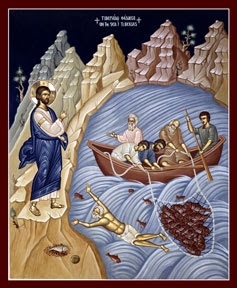
After this Jesus revealed himself again to the disciples by the Sea of Tiberias, and he revealed himself in this way. Simon Peter, Thomas (called the Twin), Nathanael of Cana in Galilee, the sons of Zebedee, and two others of his disciples were together. Simon Peter said to them, “I am going fishing.” They said to him, “We will go with you.” They went out and got into the boat, but that night they caught nothing.

Just as day was breaking, Jesus stood on the shore; yet the disciples did not know that it was Jesus. Jesus said to them, “Children, do you have any fish?” They answered him, “No.” He said to them, “Cast the net on the right side of the boat, and you will find some.” So they cast it, and now they were not able to haul it in, because of the quantity of fish. That disciple whom Jesus loved therefore said to Peter, “It is the Lord!” When Simon Peter heard that it was the Lord, he put on his outer garment, for he was stripped for work, and threw himself into the sea. The other disciples came in the boat, dragging the net full of fish, for they were not far from the land, but about a hundred yards off.

When they got out on land, they saw a charcoal fire in place, with fish laid out on it, and bread. Jesus said to them, “Bring some of the fish that you have just caught.” So Simon Peter went aboard and hauled the net ashore, full of large fish, 153 of them. And although there were so many, the net was not torn. Jesus said to them, “Come and have breakfast.” Now none of the disciples dared ask him, “Who are you?” They knew it was the Lord. Jesus came and took the bread and gave it to them, and so with the fish. This was now the third time that Jesus was revealed to the disciples after he was raised from the dead. (John 21:1-14)

Collect of the Day:

Almighty God, by the glorious resurrection of Your Son, Jesus Christ, You destroyed death and brought life and immortality to light. Grant that we who have been raised with Him may abide in His presence and rejoice in the hope of eternal glory; through the same Jesus Christ, our Lord, who lives and reigns with You and the Holy Spirit, one God, now and forever.


Tuesday, April 19, 2022

Easter Tuesday


Today is Easter Tuesday as we continue to celebrate the Resurrection of Our Lord.  The Gospel lesson for today is Luke 24:36-49:

 Scripture reading:

As they were talking about these things, Jesus himself stood among them, and said to them, "Peace to you!" But they were startled and frightened and thought they saw a spirit. And he said to them, "Why are you troubled, and why do doubts arise in your hearts? See my hands and my feet, that it is I myself. Touch me, and see. For a spirit does not have flesh and bones as you see that I have." And when he had said this, he showed them his hands and his feet. And while they still disbelieved for joy and were marveling, he said to them, "Have you anything here to eat?" They gave him a piece of broiled fish, and he took it and ate before them. Then he said to them, "These are my words that I spoke to you while I was still with you, that everything written about me in the Law of Moses and the Prophets and the Psalms must be fulfilled." Then he opened their minds to understand the Scriptures, and said to them, "Thus it is written, that the Christ should suffer and on the third day rise from the dead, and that repentance and forgiveness of sins should be proclaimed in his name to all nations, beginning from Jerusalem. You are witnesses of these things. And behold, I am sending the promise of my Father upon you. But stay in the city until you are clothed with power from on high."

 Collect of the Day:

Almighty God, through the resurrection of Your Son You have secured peace for our troubled consciences. Grant us this peace evermore that trusting in the merit of Your Son we may come at last to the perfect peace of heaven; though the same Jesus Christ, Your Son, our Lord, who lives and reigns with You and the Holy Spirit.