Tuesday, December 21, 2021

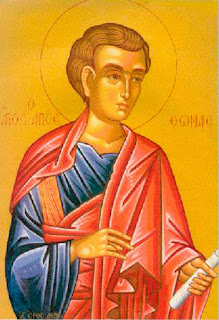
Feast of St. Thomas, Apostle


Today is the Feast of St. Thomas, Apostle.  Thomas, called Didymus (“the Twin”) is mentioned in all four Gospels as one of the twelve apostles.  John’s Gospel portrays Thomas as being slow to understand.  Although he expresses doubt about the resurrection, Thomas makes the confession that is the climax of John’s Gospel when he says to the risen Jesus, “my Lord and my God” (John 20:24-29).  According to tradition, Thomas engaged in missionary work in Persia and India where he was martyred for the faith by being speared to death.

 Scripture reading:

Now Thomas, one of the Twelve, called the Twin, was not with them when Jesus came. So the other disciples told him, “We have seen the Lord.” But he said to them, “Unless I see in his hands the mark of the nails, and place my finger into the mark of the nails, and place my hand into his side, I will never believe.”  Eight days later, his disciples were inside again, and Thomas was with them. Although the doors were locked, Jesus came and stood among them and said, “Peace be with you.” Then he said to Thomas, “Put your finger here, and see my hands; and put out your hand, and place it in my side. Do not disbelieve, but believe.” Thomas answered him, “My Lord and my God!” Jesus said to him, “Have you believed because you have seen me? Blessed are those who have not seen and yet have believed.”    (John 20:24-29)

 Collect of the Day:

Almighty and ever-living God, You strengthened Your apostle Thomas with firm and certain faith in the resurrection of Your Son.  Grant us such faith in Jesus Christ our Lord and our God, that we may never be found wanting in Your sight; through the same Jesus Christ, who lives and reigns with You and the Holy Spirit, one God, now and forever.


Sunday, December 19, 2021

Sermon for the Fourth Sunday in Advent - Rorate Coeli - Jn 1:19-28


Advent 4

                                                                                      Jn 1:19-28

                                                                                      12/19/21


          If you were among the religious leaders of Jerusalem when John the Baptist began his ministry, there was cause for concern.  There would be a history of prophet like figures showing up in the wilderness.  These men often drew a following.  Israel had been in the wilderness before Yahweh had brought them across the Jordan River, and then enabled them to conquer the promised land.

          At the moment, it was not the Canaanites who ruled the land, but instead the Romans.  The people longed to be freed from rule by these Gentiles.  It wasn’t hard to recognize that movements like this could be dangerous. The Romans weren’t going to tolerate any potential threat.  In the later instances that we know about, the reaction was to send out troops and slaughter the people.  And things could get out of hand.  The Romans had not forgotten that there had been a revolt in 6 A.D. that had to be put down using legionary forces brought down from Syria.

          John the Baptist was on the other side of the Jordan River carrying out his ministry. He was drawing very large crowds, and the leaders needed to find out what exactly was going on.  We learn that priests and Levites were sent from Jerusalem to ask him, “Who are you?”  We are told: “He confessed, and did not deny, but confessed, ‘I am not the Christ.’”  Right from the start John took the big one off the table.  He made no claim to be the Christ – the Messiah – sent by God to bring his end time salvation.

          So next, his questioners began to run through the list of expected end time figures. They asked him, “What then? Are you Elijah?” Elijah had been taken up by God in a whirlwind. God had declared through the prophet Malachi, “Behold, I will send you Elijah the prophet before the great and awesome day of the LORD comes.”  Yet John told them, “I am not.”

          Then they asked, “Are you the Prophet?” We hear in our Old Testament lesson about the prophet like Moses promised by God.  There seems to have been different versions of this expectation present in first century Judaism. But John replied: “No.”

          It’s hard not to sympathize with John’s questioners at this point. They had run out of all the obvious possibilities, and they were at a loss. They had been sent to learn information about John, and thus far they had come up with nothing. So they said to him, “Who are you? We need to give an answer to those who sent us. What do you say about yourself?” 

          John replied, “I am the voice of one crying out in the wilderness, ‘Make straight the way of the Lord,’ as the prophet Isaiah said.” John quoted Isaiah in a typically Jewish way that compressed the content of several verses into his one statement.  As we heard in last week’s Old Testament lesson, Isaiah had written, “A voice cries: ‘In the wilderness prepare the way of the LORD; make straight in the desert a highway for our God. Every valley shall be lifted up, and every mountain and hill be made low; the uneven ground shall become level, and the rough places a plain.’”

          John the Baptist made a dramatic claim. He said that he was the fulfillment of Isaiah’s prophecy.  He was the voice in the wilderness who has preparing the way for the Lord.  He was the one who was calling for the way to be made straight – for every obstacle to be removed.

          As the last of the Gospel writers, John assumes that his readers are familiar with many aspects of the basic story about Jesus.  Unlike Matthew, Mark, and Luke, he doesn’t emphasize the call to repentance issued by John the Baptist.  But that call is still clearly present here.  John was the one telling his hearers to “Make straight the way of the Lord.” 

As we prepare to celebrate the coming of the Lord at Christmas, John’s words call us to remove all those things that hinder our focus on Jesus Christ.  They call us to repent of all distractions that receive more attention than Jesus himself. Ask yourself this question: During the last three weeks have you spent more time decorating for Christmas, baking for Christmas, planning for Christmas and buying presents for Christmas than you have spending time in God’s house, reading God’s word, and praying? John’s words call us to repent and to turn our attention to the Lord, his Word, and prayer as the true spiritual preparation for the celebration of our Lord’s birth.

John’s questioners still did not have a clear answer they could understand. So they asked him, “Then why are you baptizing, if you are neither the Christ, nor Elijah, nor the Prophet?”  As I mentioned last week, ritual washings were very common in Judaism.  But these were all self-administered.  John was completely different because he applied the water to others.  The Jewish religious leaders were asking what authority he had to do this if he wasn’t one of these prominent figures.

John’s answer wasn’t about himself.  Instead, it focused on the One coming after him.  John’s authority to baptize was to be found in this One.  He answered, “I baptize with water, but among you stands one you do not know, even he who comes after me, the strap of whose sandal I am not worthy to untie.”  John seemed like a big deal.  After all, crowds were going out to see him and he had even been given the “title” – “the baptizer.”  But John declared that his ministry was only about preparation for One who was far superior to him.

In the verses after our text, we learn that this interaction took place in the time after John had baptized Jesus. We hear: “The next day he saw Jesus coming toward him, and said, ‘Behold, the Lamb of God, who takes away the sin of the world!’ This is he of whom I said, ‘After me comes a man who ranks before me, because he was before me.’”  John’s baptizing ministry offered forgiveness – forgiveness received at the Jordan River and not at the temple.  He had proclaimed that the coming One would gather the wheat into the barn – that he would gather the forgiven people of God. And so it is not entirely surprising that John called Jesus the “Lamb of God.”

And then John added something else.  He said that he had come baptizing with water to reveal the greater One.  In fact, this definitive revelation had occurred when Jesus was baptized because God who had sent John to baptize had told him, “He on whom you see the Spirit descend and remain, this is he who baptizes with the Holy Spirit.”  John declared, “I saw the Spirit descend from heaven like a dove, and it remained on him.” 

We saw in last week’s Gospel lesson that like the Old Testament prophets, John did not understand everything that was true about the Christ. In fact, he says things here that are true in ways that most likely John did not fully understand.  Jesus Christ is indeed the Lamb of God who takes away the sin of the world.  But during his ministry our Lord revealed that he is the sacrificial lamb who offered himself for our sins.  During Holy Week Jesus said, “Now is the judgment of this world; now will the ruler of this world be cast out. And I, when I am lifted up from the earth, will draw all people to myself.” Then the apostle John adds, “He said this to show by what kind of death he was going to die.”   

Jesus died on the cross as the sacrifice that makes atonement for our sins – that removes them as the barrier between us and the holy God.  The apostle says in his first letter, “He is the propitiation for our sins, and not for ours only but also for the sins of the whole world.”

Jesus the sacrifice was killed on the cross and buried.  But then, on Easter, God raised him from the dead.  Because Christ has defeated death in his own resurrection, his words are true: “I am the resurrection and the life. Whoever believes in me, though he die, yet shall he live, and everyone who lives and believes in me shall never die.”

John baptized with water, but he had been told that the One on whom he saw the Spirit descend and remain, was the One who baptizes with the Holy Spirit.  As the time of Jesus’ death approached, he spoke about his coming ascension and told the disciples, Nevertheless, I tell you the truth: it is to your advantage that I go away, for if I do not go away, the Helper will not come to you. But if I go, I will send him to you.” 

It is as the risen and ascended Lord that Jesus has baptized us with the Holy Spirit.  He has given the Spirit to his Church.  He gave you the Spirit and new life through baptism for there you were born again of water and the Spirit. 

Jesus has done this so that we can receive his forgiving love.  He has done this so that we can share this love with others.  Our Lord told the disciples at the Last Supper: A new commandment I give to you, that you love one another: just as I have loved you, you also are to love one another. By this all people will know that you are my disciples, if you have love for one another.”

Our text this morning speaks about the testimony, or witness, that John the Baptist gave.  He bore witness to Jesus Christ as the one who is greater than he.  And then in this chapter he went on to point to Jesus the Lamb of God who takes away the sin of the world and who baptizes with the Spirit.

The risen and ascended Lord has given the Spirit.  Jesus said to the disciples, “But when the Helper comes, whom I will send to you from the Father, the Spirit of truth, who proceeds from the Father, he will bear witness about me. And you also will bear witness, because you have been with me from the beginning.”  Today, we receive that witness through the Gospel of John and the rest of the Scriptures.

It is the witness that God himself gives to us. The apostle John writes in his first letter, “Whoever believes in the Son of God has the testimony in himself. Whoever does not believe God has made him a liar, because he has not believed in the testimony that God has borne concerning his Son. And this is the testimony, that God gave us eternal life, and this life is in his Son.” 

This is the testimony which we have received and believe. And so like John, we have received a testimony – a witness - that we are to share with others. We may not be prophesied prophets like John, but we know the whole story of how the Son of God died and rose from the dead to give us forgiveness, resurrection, and eternal life.  And so God sends us to speak this testimony – this witness – to those around us.  


Friday, December 17, 2021

Commemoration of Daniel and the Three Young Men


Today we remember and give thanks for Daniel and the Three Young Men.  Daniel the prophet  and the Three Young Men—Shadrach, Meshach, and Abednego—were among the leaders of the people of Judah who were taken into captivity in Babylon. Even in that foreign land they remained faithful to the one true God in their piety, prayer, and life. On account of such steadfast faithfulness in the face of pagan idolatry, the Three Young Men were thrown into a fiery furnace, from which they were saved by the Lord and emerged unharmed (Daniel 3). Similarly, Daniel was thrown into a pit of lions, from which he also was saved (Daniel 6). Blessed in all their endeavors by the Lord—and in spite of the hostility of some—Daniel and the Three Young Men were promoted to positions of leadership among the Babylonians (Dan 2:48–49; 3:30; 6:28). To Daniel in particular the Lord revealed the interpretation of dreams and signs that were given to King Nebuchadnezzar and King Belshazzar (Daniel 2, 4, 5). To Daniel himself the Lord gave visions of the end times.

Collect of the Day:

Lord God, heavenly Father, You rescued Daniel from the lions’ den and the three young men from the fiery furnace through the miraculous intervention of an angel.  Save us now through the presence of Jesus, the Lion of Judah, who has conquered all our enemies through His blood and taken away all our sins as the Lamb of God, who now reigns from His heavenly throne with You and the Holy Spirit, one God, now and forever.


(Treasury of Daily Prayer, 1025; Concordia Publishing House)


Wednesday, December 15, 2021

Sermon for third mid-week Advent service - Mic 5:1-5

Mid-Advent 3

                                                                                      Micah 5:1-5

                                                                                      12/15/21


          Bethlehem.  It is a name that has been driven into our consciousness as Christians.  And how can it be otherwise?  This is the place where Jesus the Christ was born into the world.  This is the place where a virgin gave birth to the incarnate Son of God who had been conceived by the work of the Holy Spirit.  Everything about our Christmas celebration is focused on the baby in the manger in Bethlehem.

          But this Christmas focus on Bethlehem blinds us to the reality that, as a place, Bethlehem was nothing.  Bethlehem is in the area of the promised land that was allotted to the tribe of Judah.  When Joshua chapter fifteen lists around a hundred cities that were located in the land of Judah, Bethlehem isn’t even mentioned.  It wasn’t large enough to make the list.

          Bethlehem was small.  However, it became incredibly significant when Yahweh said to the Samuel, “Fill your horn with oil, and go.  I will send you to Jesse the Bethlehemite, for I have provided for myself a king among his sons.” There God had Samuel anoint David as the next king of Israel.  Later, as we saw in our first mid-week Advent sermon, God promised that he would establish David’s royal lineage – that he would establish his kingdom forever.

          But as a place, Bethlehem was left behind.  David went on to capture Jerusalem and made it his capital.  The royal palace was built there.  David’s son, Solomon, built the temple there.  The city was fortified by walls and it became the best defended location in Judah. Jerusalem would the home for the Davidic king.  The kings that descended from David, such as Solomon, were born there.  Jerusalem was the place to be – the place of royal power and wealth.

          There is a note of irony in what Micah writes, because at the moment Jerusalem and the king descended from David, Hezekiah, didn’t look very powerful.  The prophet says in the first verse of our text, “Now muster your troops, O daughter of troops; siege is laid against us; with a rod they strike the judge of Israel on the cheek.”  The Assyrians were laying siege to Jerusalem and the outlook was grim.

          Yet in the previous chapter, Micah had spoken about a glorious future – in the very words that Isaiah also uses.  He says, “It shall come to pass in the latter days that the mountain of the house of the LORD shall be established as the highest of the mountains, and it shall be lifted up above the hills; and peoples shall flow to it, and many nations shall come, and say: ‘Come, let us go up to the mountain of the LORD, to the house of the God of Jacob, that he may teach us his ways and that we may walk in his paths.’ For out of Zion shall go forth the law, and the word of the LORD from Jerusalem.” The present might be grim. But Yahweh was in control and he would bring a time of salvation for his people.

          We learn about the One who will do this in our text as Micah writes, “But you, O Bethlehem Ephrathah, who are too little to be among the clans of Judah, from you shall come forth for me one who is to be ruler in Israel, whose coming forth is from of old, from ancient days.”  Bethlehem itself was small – too little to be considered much of anything.  But out of Bethlehem – not Jerusalem - God would bring his Messiah.

          We learn that the One who will come forth from Bethlehem will be the ruler for God.  We are told that “his coming forth is from of old, from ancient days.”  Now normally, this phrase would be understood as a reference to the long lineage of David.  But in this case, the language points to something more. It points to the truth expressed by the angel Gabriel when he told Mary, “The Holy Spirit will come upon you, and the power of the Most High will overshadow you; therefore the child to be born will be called holy--the Son of God.”

          The Messiah will be born in Bethlehem, yet as the Son of God he has existed for all eternity. He is the One about whom the apostle Paul wrote, “For by him all things were created, in heaven and on earth, visible and invisible, whether thrones or dominions or rulers or authorities--all things were created through him and for him.”  In the incarnation God sent forth his Son into this world.

          Micah describes the coming Messiah in words of power and might.  He says, “And he shall stand and shepherd his flock in the strength of the LORD, in the majesty of the name of the LORD his God. And they shall dwell secure, for now he shall be great to the ends of the earth. And he shall be their peace.”

          The prophet says that this One will be the source of peace.  Jesus Christ did come into the world to bring peace.  He was born in Bethlehem to do this.  But let us pause for a moment and consider that fact.  The Messiah – the Son of God – was born in a small and insignificant place.  We will see in the season of Epiphany that when the magi went looking for the one who had been born king of the Jews they went to Jerusalem. Apart from Micah’s prophecy that was shared by the chief priests and scribes, they never would have even heard of Bethlehem.

          Jesus Christ was born in our world to bring peace.  The apostle Paul told the Galatians, “But when the fullness of time had come, God sent forth his Son, born of woman, born under the law, to redeem those who were under the law, so that we might receive adoption as sons.”  We needed to be redeemed – to be set free – from the curse of the law because we break God’s law in thought, word, and deed.  We do not fear, love, and trust in God above all things and this shows up in every aspect of our life.

          We could never achieve peace with God.  In fact, as fallen people we had no desire for it. But during Advent we are preparing to celebrate the fact that God acted in an amazing and unexpected way to give us peace.  He sent his Son into the world as he was conceived by the Holy Spirit and born of the virgin Mary.  And as Micah tells us, Jesus the Christ was born in Bethlehem.

          “City of David” sounds grand, but Bethlehem was in fact nothing.  If you were choosing on the basis of worldly standards a place in Israel for the Christ to be born, Bethlehem would never enter your mind.  But the humility of the location reflects the way that Jesus Christ has won our peace.  He did this by being nailed to a cross to suffer and die.  The apostle Paul tells us, “Christ redeemed us from the curse of the law by becoming a curse for us--for it is written, ‘Cursed is everyone who is hanged on a tree.’”

          Cursed by God for or sins – cut off from God – Jesus was buried in a tomb.  And that looked like the end of things.  However, Jesus had been born in Bethlehem because of God’s promise.  He had been born there because God had chosen David and promised him: “Your house and your kingdom shall be made sure forever before me. Your throne shall be established forever.”  On the third day God raised Jesus from the dead. Ascended and exalted to the right hand of God, David’s kingdom has been established forever in the risen Lord.

          Because Jesus Christ has redeemed us, he is now our peace.  He has given us peace with God, and so we are now sons and daughters of God. We are people who possess the hope of the resurrection.  Jesus has risen from the dead, and he will return on the Last Day to raise us as well.  During Advent we prepare to celebrate Christ’s first coming.  But he will deliver the consummation of the salvation he won during his first coming, when he returns on the Last Day.

          In his first coming, he was born as a helpless baby in the nothing town of Bethlehem.  But his second coming will be one of almighty power, might, and glory. He will indeed, “stand and shepherd his flock in the strength of the Lord.”  He, the Son of God, is the One will bring what Micah described in the previous chapter when he wrote: “He shall judge between many peoples, and shall decide for strong nations far away; and they shall beat their swords into plowshares, and their spears into pruning hooks; nation shall not lift up sword against nation, neither shall they learn war anymore.”  The Messiah born in Bethlehem will bring the eternal peace as we live with God in the new creation.     


Sunday, December 12, 2021

Sermon for the Third Sunday in Advent - Gaudete - Mt 11:2-10


Advent 3

                                                                                      Mt 11:2-10

                                                                                      12/12/21


          John the Baptist was a big deal. And I don’t say that just because of what the Gospels of the New Testament tell us about him and his importance. Writing some sixty year years after John’s death, the Jewish historian Josephus tells us about John’s ministry.  John made such an impression on people that he was remembered decades later, and Josephus considered John the Baptist to be historically important – someone that merited inclusion in the history that he was writing.

          John showed up in the wilderness of Judea.  He was certainly an unconventional figure.  Matthew tells us that John wore a garment of camel's hair and a leather belt around his waist, and that his food was locusts and wild honey.  His dress recalled the way the prophet Elijah is described in the Old Testament.

          John had a simple message: “Repent, for the kingdom of heaven is at hand.”  He called people to repent because the kingdom of heaven – the end time reign of God – was about to arrive. And John did something that was very unusual – as far as we know, he was the first person to ever do it.  He baptized people.  Now first century Judaism was very familiar with ritual washings.  But all of these were self-administered.  John was unique in that he administered the baptism to others.  It is for this reason that John was known as “the baptizer.”

          John called people to repent because God’s reign was about to arrive. They demonstrated this repentance by submitting to John’s baptism.  Matthew tells us, “Then Jerusalem and all Judea and all the region about the Jordan were going out to him, and they were baptized by him in the river Jordan, confessing their sins.”

          John called people to repent because the kingdom of heaven was at hand. And he left no doubt about what this meant.  He said, “I baptize you with water for repentance, but he who is coming after me is mightier than I, whose sandals I am not worthy to carry. He will baptize you with the Holy Spirit and fire. His winnowing fork is in his hand, and he will clear his threshing floor and gather his wheat into the barn, but the chaff he will burn with unquenchable fire.”

          John spoke of one coming after him who would be far mightier than he.  This coming one would bring God’s end time judgment.  He would carry out the separation of the Last Day.  He would bring salvation to God’s people, and judgment upon the wicked.  He would gather the wheat into the barn.  But the chaff he would burn with unquenchable fire.

          Jesus began his ministry by coming to receive John’s baptism.  John perceived that there was something amiss. He said, “I need to be baptized by you, and do you come to me?” But Jesus said to John, “Let it be so now, for thus it is fitting for us to fulfill all righteousness.”  Jesus told John that this was part of God’s saving action to put all things right.  Jesus was the coming one, and receiving John’s baptism was part of his end time work.

          In chapter four Matthew tells us, “Now when he heard that John had been arrested, he withdrew into Galilee.”  The start of Jesus’ ministry in Galilee coincides with John’s imprisonment.  King Herod Antipas had divorced his wife, and married the daughter of a king, who had divorced his brother Phillip in order to be with Herod.  Herod had married his brother’s wife.  John the Baptist was a prophet whose ministry was to call people to repentance.  He called all people to repentance, and like prophets before him in Israel this included kings.  King Herod wasn’t going let this go on. So he had John imprisoned.

          Matthew introduces Jesus’ ministry in Galilee by saying, “And he went throughout all Galilee, teaching in their synagogues and proclaiming the gospel of the kingdom and healing every disease and every affliction among the people. So his fame spread throughout all Syria, and they brought him all the sick, those afflicted with various diseases and pains, those oppressed by demons, epileptics, and paralytics, and he healed them. 

And great crowds followed him from Galilee and the Decapolis, and from Jerusalem and Judea, and from beyond the Jordan.”

          Jesus proclaimed that the kingdom of God – the reign of God – had arrived in his person.  But Jesus was more than talk. His miracles of healing demonstrated the truth of this.  In fact, the miracles themselves were the reign of God present and already at work.  In the chapter after our text, the Pharisees accuse Jesus of being able to cast out demons because he is in league with Satan. After pointing out the absurdity of this claims – after all, why would the Satan harm his own rule? – Jesus said: “But if it is by the Spirit of God that I cast out demons, then the kingdom of God has come upon you.”

          John sat in prison, but even there he heard about the deeds of the Christ.  He heard about the miracles that Jesus was doing.  And for John, it didn’t make sense. Yes, Jesus was doing amazing things.  However, nothing had changed.  The wicked were still in the world.  In fact, a wicked man was running John’s world as he had him locked up in prison.  John had expected the coming one to bring God’s end time judgment that did away with the evil forever. He was supposed to burn up the chaff with unquenchable fire.

So John sent a question to Jesus by means of his disciples: “Are you the one who is to come, or shall we look for another?” It was a real question that arose out of John’s confusion. And if we are honest, it is a question that arises in our minds too.

We are preparing to celebrate Christmas.  We have put up Christmas trees and our homes are decked out for the season.  We prepare to celebrate the birth of Jesus Christ – an event announced by angels. But what has changed since Jesus’ birth?  Every morning I pray for members of our congregation and others. I have an actual list, and it’s a rather long list filled with people who have cancer, or mental illness, or health problems that threaten their life or make it hard.  It’s a list filled with people who are dealing with relationships that are messed up and make life challenging.  And then beyond that look around us – it’s as if the world has gone made.  We are told that girls are really boys, and boys are really girls, and if you happen to point out that a person really is one or the other – then you are the one who is the problem in society.

When Jesus received John’s question he answered: “Go and tell John what you hear and see: the blind receive their sight and the lame walk, lepers are cleansed and the deaf hear, and the dead are raised up, and the poor have good news preached to them. And blessed is the one who is not offended by me.”

These are all miracles that Jesus has been doing – in fact they have just been narrated in Matthew’s Gospel.  They are also words that quote or allude to several passages from Isaiah that describe God’s end time salvation.  Jesus’ answer back to John is an absolute yes.  He told John that yes, he is the coming one.  The miracles themselves were the presence of God’s reign.

But then Jesus added: “And blessed is the one who is not offended by me.”  Our Lord admitted that though miraculous, what he was doing did not look like John expected.  He wasn’t bringing the last day. And actually, things were only going to look even less like what John thought they should be.

Jesus had received John’s baptism in order take on the role of the suffering Servant – the one who suffers and dies for the sins of others.  Even as Jesus performed mighty miracles he told his disciples, “The Son of Man is about to be delivered into the hands of men, and they will kill him, and he will be raised on the third day.”  The baby whose birth we celebrate at Christmas came into this world to suffer and die on a cross.

The world around us celebrates Christmas. Of course they do – they’ve turned it into a rocking good time.  But the world doesn’t pay any attention to Good Friday.  And why would it? Jesus died in the weakness and failure of the cross. He ended up as just one more individual that was crushed by the injustice, the cruelty, and the evil of this world.

Jesus was crucified and buried. But he didn’t stay dead. On the third day, God raised Jesus from the dead.  In that resurrection, his disciples learned that Good Friday had in fact been something far different that it appeared.  Rather than weakness and failure, it was God’s single great act to take away our sin – to reconcile us to himself. And Jesus had passed through death in order to defeat it forever.  Risen from the dead with a body that can never die again, Jesus then ascended into heaven as he was exalted to the right hand of the Father.

Our Lord has now given us the Gospel – the good news of what he had done for us in his death and resurrection.  He has given us his word of Scripture.  He has given us Holy Baptism by which we share in his saving death.  He given us Holy Absolution through which he speaks forgiveness to us.  He has given us the Sacrament of the Altar through which the exalted Lord gives us his true body and blood, given and shed for us.  Through all of these means the Spirit of Christ gives us forgiveness and strengthens us in faith toward the risen Lord.

Like Jesus’ answer to John, our Lord’s answer to us is: “And blessed is the one who is not offended by me.”  Jesus’ saving ministry did not look like what John expected as he sat in prison. Jesus’ saving ministry in our day probably does not look like what we want it to be as we, our family, and friends suffer in a fallen world. But because Jesus is the risen Lord his saving work is indeed powerfully present in our midst. Because the One crucified on Good Friday has risen from the dead and shown us what Good Friday really meant for us, we can now trust him in the midst of circumstances that make no sense to us.  We can do this because Christ has revealed the depths God’s love for us in a way we never would have expected.

And because we know Jesus Christ as the risen and ascended Lord, we now understand that he is also exactly the coming One John expected.  We heard about this in our Gospel lesson last Sunday.  Christ who came as a humble baby at Christmas will return on the Last Day.  He will raise the dead.  He will judge all people.  Those who have believed in him – who have been baptized into his forgiving death and resurrection – will be gathered to live with him forever in the new creation. Those who have rejected Jesus Christ will be judged on the basis of their own sins. They will face the eternal judgment that John the Baptist described with the metaphor of chaff being burned up with unquenchable fire. 

And John the Baptist? Here will be there with us to see that Jesus is the coming one he foretold.  In our text Jesus says that John is a prophet – more than a prophet because he is the promised Elijah who prepares the way for the Lord as he brings the end times. The apostle Peter tells us, “Concerning this salvation, the prophets who prophesied about the grace that was to be yours searched and inquired carefully, inquiring what person or time the Spirit of Christ in them was indicating when he predicted the sufferings of Christ and the subsequent glories.” The prophets didn’t always understand how exactly God was going to fulfill the prophecies that were being delivered through them.

John didn’t understand that the coming one would come to this world twice. During Advent we prepare to remember that the Son of God became flesh in order to bring God’s saving reign by suffering and dying on the cross. But the risen and the exalted Lord will return a second time to do exactly what John expected. Jesus sent word back to John to sustain him in faith. We hear the same word today and it does this for us as well: “Go and tell John what you hear and see: the blind receive their sight and the lame walk, lepers are cleansed and the deaf hear, and the dead are raised up, and the poor have good news preached to them. And blessed is the one who is not offended by me.” 


Wednesday, December 8, 2021

Sermon for the second mid-week Advent service - Isa 7:1-17


Mid-Advent 2

                                                                                      Isa 7:1-17

                                                                                      12/8/21


It was a time of crisis as the southern kingdom of Judah was caught up in the changing politics of the Near Easten world.  The Assyrian Empire, with its capital in what is today northern Iraq, was clearly the ascendant superpower.  There was no doubt about its intentions.  It would seek to conquer all the surrounding nations, and certainly it would have Egypt as its target.

The nation of Syria and the northern kingdom of Israel saw the threat, and they formed an alliance in order to defend against Assyria.  They wanted the southern kingdom of Judah to be part of the alliance as well. But Ahaz, the king of Judah had refused.  So Syria and Israel attacked Judah during the years 735 to 733 B.C. They defeated Ahaz in battles, and took fortified cities in Judah.  They had not yet been able to take Jerusalem.  But clearly, a siege was coming. Rezin the king of Syria, and Pekah the king of Israel planned on taking Jerusalem, and then replacing Ahaz with a puppet ruler who would do their bidding.

Ahaz knew that he could not stand against Syria and Israel.  He had formed a plan, and perhaps was already setting it into motion. He would ask Assyria for help against Syria and Israel.  Now this was not simply a matter of politics.  To enter into a covenant with Assyria would be to submit to her gods.

It was in this setting that Yahweh told Isaiah to take his son and go meet Ahaz where he was inspecting the water supply that would be critical in the upcoming siege. Yahweh’s message to King Ahaz was simple: “Be careful, be quiet, do not fear, and do not let your heart be faint because of these two smoldering stumps of firebrands, at the fierce anger of Rezin and Syria and the son of Remaliah.”

Yahweh told Ahaz not to fear.  He described the kings of Syria and Israel as smoldering sticks – not threatening fire.  And then in the most direct way possible, he said through Isaiah, “thus says the Lord GOD: ‘It shall not stand, and it shall not come to pass.’”  Yahweh announced through his prophet that Syria and Israel would never take Jerusalem.  In fact, quite the opposite, these nations would cease to be any kind of threat at all.  And then the Lord said, “If you are not firm in faith, you will not be firm at all.”

God called Ahaz to trust in him.  He declared that Syria and Israel would never be successful against Judah.  Ahaz needed to believe and trust the word of Yahweh.  The way of faith was the only way that could bring safety to Jerusalem and Judah. Any other attempt by Ahaz to solve the problem would result in failure.

This is the same basic question that faces us in life all the time.  Do we believe and trust in God or not?  In the face of circumstances that threaten us, do we trust in God to care for us? Ahaz had sized up the situation, and had already decided that it was foolish to trust in Yahweh. The forces of Syria and Israel were just too strong.  Instead, he would solve the problem by asking Assyria for help.  How do we respond to bad news about our health or job?  How do we respond to developments that affect our family and friends?  Do we trust and believe in God fully?  Or does doubt creep in about whether God really is in control?  Do we begin to wounder about whether God really does care?

We hear in our text that again Yahweh spoke to Ahaz through the prophet Isaiah.  He said: “Ask a sign of the LORD your God; let it be deep as Sheol or high as heaven.”  God invited Ahaz to act in faith.  He told Ahaz to ask for a sign – something God would do - by which Yahweh would demonstrate the truth of his promise. But Ahaz was not a man of faith.  He pretended to be pious and humble as he said, “I will not ask, and I will not put the LORD to the test.” Yet the reality was that he didn’t want anything to do with faith in Yahweh.  He was going to act on the basis of his own plans. He was going to count on Assyria and not Yahweh.

So Isaiah responded: “Hear then, O house of David! Is it too little for you to weary men, that you weary my God also? 

Therefore the Lord himself will give you a sign. Behold, the virgin shall conceive and bear a son, and shall call his name Immanuel. He shall eat curds and honey when he knows how to refuse the evil and choose the good. For before the boy knows how to refuse the evil and choose the good, the land whose two kings you dread will be deserted. The LORD will bring upon you and upon your people and upon your father's house such days as have not come since the day that Ephraim departed from Judah--the king of Assyria.”

          Yahweh announced that he would give Ahaz a sign.  A virgin would conceive and bear a son.  And before that boy had matured, the land of the kings whom Ahaz feared – those of Syria and Israel – would be conquered and deserted.  They would be, because Yahweh was bringing something so traumatic that nothing like it had occurred since the days when God’s people split into the northern and southern kingdoms.  God was bringing the king of Assyria and his mighty empire.  This is what Ahaz wanted, but Assyria wouldn’t stop with Syria and Israel.  It would bring destruction upon Judah as well.

          Now for Isaiah’s words to have any meaning for the people living in the eighth century B.C., it had to have a fulfilment at that time.  God has announcing that a maiden of that time – someone who was naturally a virgin and perhaps of the royal house – would give birth to a son. The key feature was not how the child would be conceived, because when she conceived she would have a husband.  Instead, it was the fact that God was providing a child at that time – a child named Immanuel, God with us – as a sign of what was going to happen.

          Yet if that was all that Isaiah’s words meant, then they wouldn’t have any meaning for us.  And as we continue reading in this portion of Isaiah we learn that these events that Israel and Judah were experiencing were part of something much bigger. They were events that pointed forward to a much greater action by God. 

We again here about a child in chapter nine, and this is clearly no ordinary baby.  Isaiah says: “For to us a child is born, to us a son is given; and the government shall be upon his shoulder, and his name shall be called Wonderful Counselor, Mighty God, Everlasting Father, Prince of Peace. Of the increase of his government and of peace there will be no end, on the throne of David and over his kingdom, to establish it and to uphold it with justice and with righteousness from this time forth and forevermore. The zeal of the LORD of hosts will do this.” This child is the Davidic king.  But he is mysteriously more.  He is Mighty God.

The fulfillment of this action by God occurred in the first century A.D.  In this case a virgin did conceive – and yet there was no human father involved.  We hear about this in our reading from Luke chapter one as the angel Gabriel announces what will happen to Mary.  But I want to focus on Matthew’s account which tells about Joseph’s experience because it quotes our text.

Joseph and Mary were betrothed – a legal arrangement that led to marriage. However, it was discovered that Mary was pregnant.  Joseph wasn’t going to marry a woman who had been unfaithful before they had even had a wedding night. He was going to divorce her – end the betrothal.  Yet we learn that as he considered these things an angel of the Lord appeared to him in a dream, saying, “Joseph, son of David, do not fear to take Mary as your wife, for that which is conceived in her is from the Holy Spirit. She will bear a son, and you shall call his name Jesus, for he will save his people from their sins.”

Then Matthew tells us: “All this took place to fulfill what the Lord had spoken by the prophet: ‘Behold, the virgin shall conceive and bear a son, and they shall call his name Immanuel’ (which means, God with us).”  The “how” of the Messiah – the Christ sent by God – is that the Holy Spirit caused Mary to conceive.  And this is no ordinary child – he truly is Immanuel – God with us.  He is the Son of God in the flesh.  He is true God and true man.

His name is Jesus, which means “the Lord saves” because he is the One who has saved us from our sins.  He did this, not by some victory that drew the praise and awe of all. Instead, he did it by suffering and dying on the cross for us.  He did it as he was forsaken by God, so that we will never will be.

But Jesus the Christ is the One through whom the Lord saves. On the third day God raised Jesus from the dead.  Our Lord has won the forgiveness of sins for us.  He has conquered death.  He is the risen and ascended Lord who is still Immanuel – God with us – as he comes to us through his Means of Grace.  During Advent we prepare to celebrate that the Son of God entered into our world – conceived by the Holy Spirit and born of the virgin Mary - in order to save us.  And we look with eager expectation to the day of his return when he will be God with us in glory.