Tuesday, July 6, 2021

Commemoration of Isaiah


Today we remember and give thanks for the prophet Isaiah.  Isaiah son of Amoz is considered to be the greatest of the writing prophets and is quoted in the New Testament more than any other Old Testament prophet. His name means “Yahweh [the Lord] saves.” Isaiah prophesied to the people of Jerusalem and Judah from about 740 B.C. to 700 B.C. and was a contemporary of the prophets Amos, Hosea, and Micah. Isaiah was a fierce preacher of God’s Law, condemning the sin of idolatry. He was also a comforting proclaimer of the Gospel, repeatedly emphasizing God’s grace and forgiveness. For this he is sometimes called the “Evangelist of the Old Testament.” No prophet more clearly prophesied about the coming Messiah and his saving kingdom. He foretold the Messiah’s miraculous birth (Is 7:14; 9:6), his endless reign (Is 2:1–5; 11:1–16), and his public ministry (Is 61:1–3), but most notably his “Suffering Servant” role and atoning death (52:13—53:12). The apostle John’s description of Isaiah, that Isaiah saw Jesus’ glory and spoke of him (John 12:41), is an apt summary of Isaiah’s prophetic ministry.

Collect of the Day:

Lord God, heavenly Father, through the prophet Isaiah, you continued the prophetic pattern of teaching your people the truth faith and demonstrating through miracles your presence in creation to heal it of its brokenness.  Grant that your Church may see in your Son, our Lord Jesus Christ, the final end-times prophet whose teaching and miracles continue in your Church through the healing medicine of the Gospel and the Sacraments; through Jesus Christ, our Lord, who lives and reigns with You and the Holy Spirit, one God, now and forever.


Sunday, July 4, 2021

Sermon for the Fifth Sunday after Trinity - Lk 5:1-11

Trinity 5

                                                                                       Lk 5:1-11

                                                                                       7/4/21


            Last summer we had to replace the double doors that are at the entrance to our house.  While the right door is the one that opens as you enter the house, the left door can also be unlocked at the top and bottom to open.  Over the years this has proven to be handy as we have brought furniture in and out of the house.

            We had ordered the doors from a store, and when I went to pick them up I was shocked to see how big the assembly really is when it is sitting out on its own and not part of the house.  Thankfully, Jay Will was helping me pick it up in his truck.  While the workers at the store helped us load the doors, they were really too big for the two of us to unload by ourselves at my house.  Jay was able to call a co-worker who lives a couple of houses down from us to come over, and the three of us – with great effort – were able to get it unloaded and put into the garage.

            Once there, one of my kids asked whether I was going to install the doors. I laughed, and replied that no – there was no way that I would be able to do it.  He had seen me do the basic wood working in building the model railroad, and I had involved him in various repair projects around the house to teach him how to do these things.  These experience had led him to the natural assumption: “Dad can do that.”

            But in reality – no – dad can’t do that.  I know that I am able to do basic repairs.  But when you get into real carpentry and construction issues, or plumbing or electrical problems, I have to hire someone who knows how to do those things.  And when they come to do repairs, I certainly don’t try to tell them what to do.  After all, I would only make a fool of myself because I know nothing about how things are to be done.

            In our Gospel lesson this morning, Jesus tells a professional fisherman how to fish.  His words indicate that he knows nothing about how things are to be done.  But because it is a word from Jesus, Peter follows his instruction. And that word produces an amazing catch of fish, that overwhelms Peter as he is in the presence of Jesus.

            Luke begins the Gospel lesson by saying: “On one occasion, while the crowd was pressing in on him to hear the word of God, he was standing by the Lake of Gennesaret.” We learn that the crowd was pressing in on Jesus.  This was obviously a crowed that felt driven to get close to Jesus.  And the reason they wanted to get close to him was to hear the word of God.

            Now we know that Jesus speaks the word of God, because he is the Son of God. We know that he was sent forth by the Father as he was conceived by the Holy Spirit and born of the virgin Mary.  But what is it that has drawn these people to hear Jesus?  What has led this crowd to press in on Jesus in order to hear him?

            In the previous chapters we learn how the Holy Spiri descended upon Jesus at his baptism. Then Luke tells us: “And Jesus returned in the power of the Spirit to Galilee, and a report about him went out through all the surrounding country. And he taught in their synagogues, being glorified by all.”  As the Christ, the One anointed with the Holy Spirit, Jesus went forth with power to carry out the mission the Father had given to him. Jesus announced what this mission was when he read the words of Isaiah chapter 61 in the synagogue at Nazareth, and declared that he was the fulfillment of them. Those words said: "The Spirit of the Lord is upon me, because he has anointed me to proclaim good news to the poor. He has sent me to proclaim liberty to the captives and recovering of sight to the blind, to set at liberty those who are oppressed, to proclaim the year of the Lord's favor.” 

            People recognized that Jesus’ Spirit empowered ministry was different. We learn that when Jesus went to Capernaum and was teaching in the synagogue the people “were astonished at his teaching, for his word possessed authority.”  And it wasn’t just that they sensed the authority of Jesus’ word.  They also saw it at work.

            At the synagogue a man who was demon possessed cried out, “Ha! What have you to do with us, Jesus of Nazareth? Have you come to destroy us? I know who you are--the Holy One of God.” However, Jesus rebuked him, saying, “Be silent and come out of him!” as he cast the demon out. The people were all amazed and said to one another, “What is this word? For with authority and power he commands the unclean spirits, and they come out!” 

Luke tells us that reports about him went out into every place in the surrounding region.

            People could tell that Jesus’ word had authority when he spoke.  They could see that his word had power and authority as he cast out demons and healed people. It was not surprising then, that a crowd was pressing in to hear Jesus as he stood by the Lake of Gennesaret – the Sea of Galilee. There Jesus saw two boats by the lake, where the fishermen had gone out of them and were cleaning their nets.  Jesus got into the boat that belonged to Simon Peter and asked him to put out from the land a little.  Jesus interrupted Peter’s work, but Peter was willing to help as Jesus sat in the boat and taught the people on the shore.

            When Jesus was done speaking, he did something surprising. He told Simon, “Put out into the deep and let down your nets for a catch.”  Jesus, who wasn’t a fisherman, told the professional fisherman how to fish. And what he said was dumb – it made no sense.  Fishermen worked at night on the lake. That was the best time to catch fish with their nets. Peter knew this.  He pointed this out as he said, “Master, we toiled all night and took nothing!”  Yet then he added: “But at your word I will let down the nets.”

            Notice that it was Jesus’ word that caused Peter to do something that he thought was foolish.  And notice too, that he called Jesus “master,” a term that in Luke’s Gospel is only used by those who approach Jesus in faith.  Because it was Jesus’s word, Peter was willing to set aside his own ideas, and do what Jesus had said.

            This same question confronts us every day.  In the very next chapter Jesus teaches: “But I say to you who hear, Love your enemies, do good to those who hate you, bless those who curse you, pray for those who abuse you.”  This too sounds dumb. It makes no sense.  Everyone knows that this is not how you do things. You don’t love, and help and pray for those who wrong you.  Yet this is what Jesus says to do. This is his word.  And so the question is whether we are willing to set aside our own ideas, and do what Jesus has said.

            Peter did what Jesus said, even though it seemed to make no sense. He listened to Jesus’ word and put it into action. Luke tells us, “And when they had done this, they enclosed a large number of fish, and their nets were breaking. They signaled to their partners in the other boat to come and help them. And they came and filled both the boats, so that they began to sink.”  Jesus’ “foolish word” about how to catch fish, produced such a large catch that it was swamping the boats.

            Jesus’ word had produced an incredible event – an astounding catch of fish.  Peter, was astonished by the catch.  Yet his reaction was not joy and excitement. Instead, Luke tells us: “But when Simon Peter saw it, he fell down at Jesus' knees, saying, ‘Depart from me, for I am a sinful man, O Lord.’”  Peter perceived that he was being confronted by God’s work and power in the person of Jesus.  Where before he had called Jesus “master,” now he called him “Lord.” 

            Peter did what people always do in Scripture when they find themselves in the presence of the holy God.  In a profound and overwhelming way he perceived his own sinfulness. He knew he did not belong there.

            This is our experience too when we compare our lives – our thoughts, words, and deeds – to what God has revealed in his word.  Jesus says, “Love your enemies, do good to those who hate you, bless those who curse you, pray for those who abuse you.”  We hear these words and know that we fail to do them. And of course what is true here, is also true again and again in every one of the Ten Commandments.  Our reaction should be no different than that of Peter: “Depart from me, for I am a sinful man, O Lord.” “Depart from me, for I am a sinful woman, O Lord.”

            But Jesus did not come to Peter to drive him away because of his sin.  Instead, he said to him, “Do not be afraid; from now on you will be catching men.”  Jesus told Peter, “Do not be afraid.”  Jesus had not been anointed by the Spirit as the Christ to bring judgment and fear.  Instead, as Isaiah had said of him: “The Spirit of the Lord is upon me, because he has anointed me to proclaim good news to the poor. He has sent me to proclaim liberty to the captives.”  In the verses immediately before our text people wanted Jesus to stay, but he said to them, “I must preach the good news of the kingdom of God to the other towns as well; for I was sent for this purpose.”

            In Jesus we meet the good news of the kingdom of God – the reign of God that has freed us from Satan, sin, and death.  Jesus did not come to condemn sinners.  Instead, he came to be numbered with the transgressors – with us.  He came to take our place as he offered himself as the sacrifice for our sin.  Christ has freed us from sin and death through his death on the cross and resurrection from the dead. This is the good news that he has brought.  This is the good news that he has accomplished for us.

            Do we still struggle with sin? Yes.  Do we still fall? Yes.  But we are not afraid.  Instead, we are repentant.  And repentance is an act of faith. We confess our sin, confident that because of Jesus’ cross and resurrection we are forgiven.  After all, as Jesus said just a couple of weeks ago in the Gospel lesson: “Just so, I tell you, there is joy before the angels of God over one sinner who repents.”

            Jesus said to Peter, “Do not be afraid; from now on you will be catching men.”  Peter believed Jesus’ word.  Instead of asking Jesus to leave, we learn: “And when they had brought their boats to land, they left everything and followed him.”

            Because of the forgiveness and salvation that we receive from our Lord, we now follow him.  This means leaving behind those things that compete with Jesus for our time and attention, as we put Jesus first. It means leaving behind the ways of the world – the ways of anger, vengeance, and payback – as we forgive others and love our enemies.

            And it also means that we seek to share the forgiveness and freedom that we have received with others.  We seek to share the Gospel – the good news of Jesus’ death and resurrection. There will be those who want to hold on to their sin.  There will be those who want to hold on to their false gods.  We recognize that only the Spirit of Christ can call people to faith. But the Spirit works through the word about Christ, and so our job is to speak that word.

            I am no fisherman, but I have done it enough to know that you don’t catch a fish every time you cast the line.  On the other hand, I know that no fish are caught if the line is never cast.  And so our role is to speak about Jesus’ death and resurrection to others, because we know that through him we are included among those who have received forgiveness and salvation.


Friday, July 2, 2021

Feast of the Visitation


Today we celebrate the Feast of the Visitation, the day when Mary went to see Elizabeth after learning that she was pregnant with the Son of God, and that Elizabeth too was pregnant.  The Church observes several days which are connected with the virgin Mary: The Purification of Mary and the Presentation of Our Lord (Feb. 2); The Annunciation of Our Lord (March 25); The Visitation (July 2); and St. Mary, Mother of Our Lord (Aug. 15).  We do this because they are festivals of the Incarnation.  On these days we confess with the Third Ecumenical Council of Ephesus (431 A.D.) that Mary was the Theotokos, the God bearer.  We confess the reality of the incarnation – that Jesus Christ was conceived by the Holy Spirit and born of the virgin Mary as the One who is true God and true man.  In addition, Mary stands out as a great example and model of faith as she trusted God’s Word.

Scripture reading:

In those days Mary arose and went with haste into the hill country, to a town in Judah, and she entered the house of Zechariah and greeted Elizabeth. And when Elizabeth heard the greeting of Mary, the baby leaped in her womb. And Elizabeth was filled with the Holy Spirit, and she exclaimed with a loud cry, “Blessed are you among women, and blessed is the fruit of your womb! And why is this granted to me that the mother of my Lord should come to me? For behold, when the sound of your greeting came to my ears, the baby in my womb leaped for joy. And blessed is she who believed that there would be a fulfillment of what was spoken to her from the Lord” (Luke 1:39-45).


Collect of the Day:

Almighty God, You chose the virgin Mary to be the mother of Your Son and made known through her Your gracious regard for the poor and lowly and despised.  Grant that we may receive Your Word in humility and faith, and so be made one with Jesus Christ, Your Son, our Lord, who lives and reigns with You and the Holy Spirit, one God, now and forever.

Tuesday, June 29, 2021

Feast of St. Peter and St. Paul


Today is the Feast of St. Peter and St. Paul.  Peter was a fisherman who was called as one of the twelve apostles and accompanied Jesus during His entire ministry (Matthew 4:18-22; 10:1-2).  He confessed that Jesus was the Christ, the Son of the living God and Jesus recognized the role of leadership that he would have in the Church (Matthew 16:13-20).  However, he also rebuked Jesus when our Lord predicted His passion (Matthew 16:21-23) and denied Jesus three times (Matthew 26:69-75).  Forgiven by our Lord and commissioned again to care for the flock (John 21:15-19) he was an important leader in the early Church (Acts 2) and God used him to indicate that the Gentiles were being received as part of the people of God (Acts 10).  He wrote two letters that are included in the New Testament.  According to Church tradition, he died a martyr when was crucified upside down in Rome.

Paul, originally named Saul, was a zealous Pharisee who persecuted the Church (Philippians 3:4-6; Galatians 1:13-16; Acts 9:1-2).  The risen Lord appeared to him on the road to Damascus and called him to be an apostle who would proclaim the Gospel to the Gentiles (Acts 9:3-18).  Paul engaged in three missionary journeys to Asia Minor and Greece (Acts 13-14, 16-18, 18-21).  While in Jerusalem he was arrested and then imprisoned by the Romans at Caesarea (Acts 22-26).  As a Roman citizen, he appealed to Caesar and at the end of the Book of Acts he is in Rome under house arrest waiting for his case to be heard (Acts 28:30-31).  Paul wrote thirteen letters that are included in the New Testament.  We have little information about the chronology of the end of Paul’s life (it may be that he was released from Rome and then was later arrested again after doing further missionary work). According to Church tradition, he died a martyr when he was beheaded in Rome 

Scripture reading:

But some men came down from Judea and were teaching the brothers, “Unless you are circumcised according to the custom of Moses, you cannot be saved.” And after Paul and Barnabas had no small dissension and debate with them, Paul and Barnabas and some of the others were appointed to go up to Jerusalem to the apostles and the elders about this question. So, being sent on their way by the church, they passed through both Phoenicia and Samaria, describing in detail the conversion of the Gentiles, and brought great joy to all the brothers. When they came to Jerusalem, they were welcomed by the church and the apostles and the elders, and they declared all that God had done with them. But some believers who belonged to the party of the Pharisees rose up and said, “It is necessary to circumcise them and to order them to keep the law of Moses.”

The apostles and the elders were gathered together to consider this matter. And after there had been much debate, Peter stood up and said to them, “Brothers, you know that in the early days God made a choice among you, that by my mouth the Gentiles should hear the word of the gospel and believe. And God, who knows the heart, bore witness to them, by giving them the Holy Spirit just as he did to us, and he made no distinction between us and them, having cleansed their hearts by faith. Now, therefore, why are you putting God to the test by placing a yoke on the neck of the disciples that neither our fathers nor we have been able to bear? But we believe that we will be saved through the grace of the Lord Jesus, just as they will.” And all the assembly fell silent, and they listened to Barnabas and Paul as they related what signs and wonders God had done through them among the Gentiles. (Acts 15:1-12 ESV)

Collect of the Day

Merciful and eternal God, your holy apostles Peter and Paul received grace and strength to lay down their lives for the sake of your Son.  Strengthen us by your Holy Spirit that we may confess your truth and at all times be ready to lay down our lives for him who laid down his life for us, even Jesus Christ, our Lord, who lives and reigns with You and the Holy Spirit, one God, now and forever.


Monday, June 28, 2021

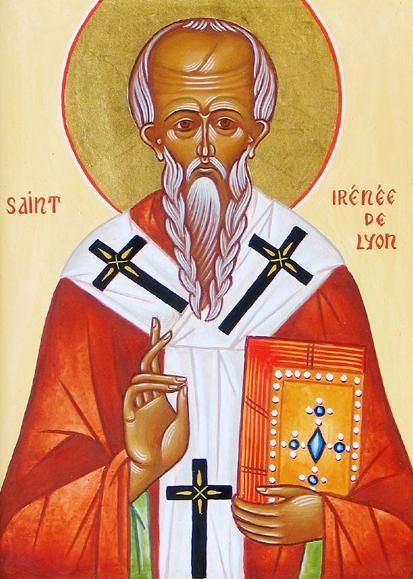
Commemoration of Irenaeus of Lyons, Pastor


Today we remember and give thanks for Irenaeus of Lyons, Pastor.  Irenaeus (ca. A.D. 130-200), believed to be a native of Smyrna (modern Izmir, Turkey), studied in Rome and later became pastor in Lyons, France. Around 177, while Irenaeus was away from Lyons, a fierce persecution of Christians led to the martyrdom of his bishop. Upon Irenaeus' return, he became bishop of Lyons. Among his most famous writings is a work condemning heresies, especially Gnosticism, which denied the goodness of creation. In opposition, Irenaeus confessed that God has redeemed his creation through the incarnation of the Son. Irenaeus also affirmed the teachings of the Scriptures handed down to and through him as being normative for the Church.

Collect of the Day:

Almighty God, You upheld Your servant Irenaeus with strength to confess the truth against every blast of false doctrine.  By Your mercy, keep us steadfast in the true faith, that in constancy we may walk in peace on the way that leads to eternal life through Jesus Christ, our Lord, who lives and reigns with You and the Holy Spirit, one God, now and forever.


Sunday, June 27, 2021

Sermon for the Fourth Sunday after Trinity - Gen 50:15-21

                                                                                  Trinity 4              

                                                                            Gen 50:15-21

                                                                             6/27/21


In the Treaty of Versailles that was signed after the end of World War I, several of the major winning nations had one goal: to punish and humiliate Germany which had started the most destructive war the world had ever seen. Germany was forced to give up is colonies in China and Africa.  It had to demilitarize the Rhineland, and give back the region of Alsace-Lorraine to France that it had taken in their 1871 war.  It had to give up German West Prussia to what became the newly independent nation of Poland.  Germany’s army and navy were limited to a laughable size.  It was not allowed to have an air force. And most damaging for a nation that was broke after four years of total war, Germany was ordered to pay $33 billion dollars in reparations – somewhere in the range of $425 billion in today’s dollars.

            The problem was that when the armistice was signed on Nov. 11, 1918, Germany was going to lose the war, but had not yet been defeated.  In fact, just in March of that year they had launched the Spring Offensive using troops newly freed up by the end of the war on the Eastern front where the Communist revolution had knocked Russia out of the war.  Initially this offensive was tremendously successful as the Germans drove to within seventy five miles of Paris.  Allied commanders were fearful that the war would be lost.

            But the allies stabilized the line and in August they launched the Hundred Days Offensive in which new tactics and the ever increasing presence of United States forces pushed the Germans back.  The German leadership knew the war could not be won, and military and civilian morale was failing. But the fact remained that when the armistice was signed, the allies had not yet entered into Germany, and Germany still held a large portion of Belgium.  This gave rise to the idea in Germany after the war that the military had been betrayed, and not defeated.  The humiliation of Versailles and the economic chaos that ensued, which then was followed by the Great Depression created the conditions in which a man name Adolf Hitler was able rise to power. He started an even more destructive Second World War. When Germany was defeated in that war, the allies learned from the mistakes of Versaille and took a very different approach toward the defeated nation.

            In the Old Testament lesson for today, we see how Joseph treated his brothers after his father Jacob died.  Rather than seek vengeance, he chooses to forgive them.  Yet in the story of Joseph and his family, we also see how sin and vengeance produce more sin and vengeance.  And we are reminded that God’s ways are beyond our understanding, even as he works for our good.

            Our text tells of the events after Jacob had died. With their father gone, his brothers said, “It may be that Joseph will hate us and pay us back for all the evil that we did to him.”  Of course the evil they had done to Joseph was to sell him into slavery and fake his death which they reported to Jacob.

            This is the obvious sin that we remember when we think about Joseph. But in fact, it is an example of how sin ripples out and produces more sin.  When sinful people live together, there will be problems.  By definition, a family is a group of sinful people living together, and so not surprisingly we all see some kind of dysfunction in our family.  Of course, there are levels of dysfunction, and if you want to see some prime time dysfunction you need only look at Jacob’s family.

            Isaac and Rebekah had twins – Jacob and Esau.  Isaac favored Esau, while Rebekah favored Jacob. First Jacob swindled Esau out of his birthright.  Then Rebekah helped Jacob trick the elderly Isaac into giving Jacob the blessing that was meant for Esau.  Esau wanted to kill Jacob, so Rebekah sent Jacob to her brother Laban.  There Jacob fell in love with Laban’s daughter Rachel, but Laban tricked Jacob into taking his other daughter Leah as a wife, and only by having Leah could Jacob also have Rachel.

            Jacob favored Rachel.  Joseph was the son of Rachel, and so Jacob favored him.  And Jacob didn’t try to hide his favoritism. Instead he gave to him alone an expensive multicolored coat.  Joseph didn’t help matters.  When he had dreams that indicated he would have authority over his brothers, and even his parents, he announced them to everyone.  Joseph’s brothers were so fed up with Joseph that they wanted to kill him. Finally, they sold him into slavery and faked his death which they reported to Jacob.

            The thing we want to note here is how sin produced more sin. Certainly, our sins are sins against the holy God. But sins violate the ordering God has given for the world.  God has revealed this ordering for a reason.  He has created the world to work in certain ways, and if you choose to do things in your own way it will not turn out well for you. Sin will produce more sin, and our lives become caught up in ever more entangled messes.

            As we live in our marriages and families, we must recognize this fact.  Each sinful action – the selfish deed and the harsh word – sends out ripples of more sin in our relationships and family.  God’s Word teaches us that as a new creation in Christ we need to crucify the old man in us. We need to follow the Spirit’s guiding and by his power resist the sin that the old Adam wants us to undertake. 

We do this because it is God’s will and pleases him. But we also do so for the sake or our spouse and family. We need to take up the struggle against sin for their sake as well.  Our choices about whether to follow sin’s temptation or whether to resist them will help determine the quality of life that we experience in our marriage and family.

            Joseph’s brothers had sold Joseph into slavery.  But God had cared for Joseph – even when he suffered for doing the right thing.  In the end, God had used Joseph to reveal to Pharaoh that seven terrible years of famine would follow seven years of plenty. Pharaoh had placed Joseph as second in charge of Egypt, storing up food during the seven good years.  When the famine arrived, it affected the whole region.  Joseph’s brothers came to Egypt to buy food, and it was in that interaction that they learned Joseph was not only alive, but had power over their lives.  Joseph had moved Jacob and the family to Egypt where he could provide for them.

            Now Jacob had died, and the brothers feared what Joseph would do to them. They didn’t come personally. Instead they sent a message to Joseph saying, “Your father gave this command before he died, ‘Say to Joseph, Please forgive the transgression of your brothers and their sin, because they did evil to you.’ And now, please forgive the transgression of the servants of the God of your father.”

            The brothers confessed their sin and asked for forgiveness.

When they actually came into his presence they fell down before Joseph and said, “Behold, we are your servants.”  But Joseph replied, “Do not fear, for am I in the place of God? As for you, you meant evil against me, but God meant it for good, to bring it about that many people should be kept alive, as they are today. So do not fear; I will provide for you and your little ones.”

            Joseph forgave his brothers. And in his action we see how we are to live as Christians because of our Lord Jesus.  St. Paul told the Ephesians, “Let all bitterness and wrath and anger and clamor and slander be put away from you, along with all malice. Be kind to one another, tenderhearted, forgiving one another, as God in Christ forgave you.”  Jesus Christ suffered and died on the cross for you.  He carried out the Father’s saving will to order to win the forgiveness of your sins.  He received the judgment you deserved so that by faith and baptism you can stand before God as one who is justified – innocent and holy in God’s eyes.

            The wages of sin is still death, and so the on the third day God raised Jesus from the dead in order to defeat death.  By his death on the cross Jesus has won forgiveness for you. By his resurrection he has given you the assurance of eternal life – a life that will share in the resurrection life of Jesus when he returns in glory on the Last Day.

            God has forgiven you in Christ.  He has done this so that now through the work of his Spirit you can forgive others.  He has done this so that you can forgive your spouse; so that you can forgive your son or daughter, your father or mother, your brother or sister. It is this forgiveness which God has given us in Christ that has the power to stop the cycle of sin. Sin against one another does not need to beget more sin against each other.  Instead, because of Jesus Christ we forgive one another. We live together in God’s forgiveness and love that we have received in Christ.

            The death and resurrection of Jesus is the source of the forgiveness we share with one another. And it is also the reason that we can trust God in the midst of all circumstances.  In our text Joesph says to his brothers, “As for you, you meant evil against me, but God meant it for good, to bring it about that many people should be kept alive, as they are today.”

            In this statement, Joseph expresses the truth that God had been in control the whole time. Joseph had been sold into slavery.  He had been sent to prison when he resisted the sexual advances of Potiphar’s wife, and then was falsely accused of seeking to assault her.  He was forgotten by Pharaoh’s cup bearer after he correctly interpreted his dream. Injustice and disappointment had been followed by injustice and disappointment. Yet now Jospeh could see what God had been doing all along. He understood that God had been working in ways that at the time were mysterious and impossible to understand.

            Now what Joseph says is true. God works for good, and he often does this in ways we don’t understand. Certainly, God’s revelation about Joseph’s life is meant teach us this. But at the same time isn’t it easy to make this statement when you are second in charge of Egypt and you see how everything has turned out great?  What are we to think when the diagnosis is cancer?  How are we to view things when we or a loved one are struggling with mental illness?  What is one to say when the plans we had for life are not turning out as we hoped?

            St. Paul told the Romans, “And we know that for those who love God all things work together for good, for those who are called according to his purpose.”  This is true. But many times it is a matter of faith because the “all things” don’t look so great. What is it that enables us to trust that God is indeed … somehow … still working good when everything we see looks bad?  It is the resurrection of Jesus Christ.

            The resurrection of Jesus is the ultimate victory.  It is the game changer that causes us to see everything differently. Remember, there did not appear to be anything good about Good Friday.  Jesus hung dead on a cross. He had been humiliated as the powerless one. The Messiah? The Son of God?  You could throw all of that stuff out the window.  He was just another messianic pretender whose claims had turned out to be lies.  That’s all there was to see at three o’clock in the afternoon. On Saturday, he was just another corpse buried in a tomb.

            But on the third day, on Easter, God raised Jesus from the dead.  He demonstrated that in fact, Jesus’ death on the cross had been God’s most powerful action to save us. In fact, Jesus had shown himself to be the Messiah and Son of God by passing through the humiliation, weakness and death of the cross.  In Jesus’ resurrection we learn that sin has been forgiven and death has now been defeated.

            This knowledge becomes the lens through which we see all of our life.  The resurrection of Jesus is the reason that we can trust that God is indeed at work for good. We may have no clue how, but we have seen him work our greatest good in the cross of Christ.  We know this because Jesus rose from the dead, and so the resurrection of Jesus is our source of confidence and trust in the midst of all circumstances.

            Jesus is Lord.  He died on the cross for us.  He rose from the dead.  Because this is so, we seek to battle against sin, and instead by Christ’s Spirit to share love and support for those in our family and all around us.  When people sin against us, we forgive, because this is what God has done for us in Jesus Christ. And in the midst of any and all circumstances we trust that God loves us and is at work for our good, because Jesus Christ has risen from the dead.  


Friday, June 25, 2021

Presentation of the Augsburg Confession


Today is the anniversary of the Presentation of the Augsburg Confession.  In late 1517 when Martin Luther initiated the events that would result in the Reformation, he had no idea regarding what was about to take place.  Luther’s Ninety-five Theses were a call for academic discussion – not for thoroughgoing reformation of the Church.  However the discussions and debates that ensued prompted Luther to further study.  This process continued to reveal the extent to which the Church’s faulty practice was based upon theology which was not true to God’s Word.

Luther was excommunicated by Pope Leo X in 1520.  He was then summoned to appear before the Holy Roman Emperor, Charles V at the Diet of Worms in 1521.  There Luther refused to recant and in the Edict of Worms Luther was declared to be “a manifest heretic.”  The edict declared that no one was to give assistance to Luther, but instead they were to take him prisoner and deliver him to the emperor.  The reading and distribution of Luther’s writings was forbidden.  It was Charles’ intention to deliver Luther over to Pope Leo X for the purpose of burning Luther at the stake. 

In 1526 at the Diet of Speyer, an ambiguous edit was passed in which the German princes promised to carry out the Edict of Worms according to their own consciences.  This provided the setting in which Elector John continued his support of the Reformation in Saxony.  However, at the Diet of Speyer in 1529 Charles V corrected the ambiguity of the1526 edict and forbade expansion of the Reformation.  This led the German princes to issue a formal appeal or “protest” (it is from this event that the term “Protestant” arose).  

However, Charles V found himself limited in his ability to act against princes and areas that supported the Reformation.  In 1529 the Turkish army had laid siege to Vienna before being turned back.  Charles faced this threat from the east, and he also was engaged in a struggle with France.  He needed the German part of his empire to be united in order to assist him.  He also had a genuine concern about the condition of the Church in the areas that he ruled.          

Charles V called for the Lutheran princes and cities to explain their religious reforms at an imperial diet that was to meet in the southern German city of Augsburg in 1530.  Luther was not able to travel to the diet because of edict passed against him in 1521and the Lutherans were led by his colleague, Phillip Melanchthon.  When the Lutherans arrived they found that a Roman Catholic opponent, John Eck, had produced a work entitled Four Hundred Four Propositions.  This work contained quotes from Luther and Melanchthon and mixed them in with heretical statements in the attempt to give the impression that the Lutherans supported most heresies known to the Church.

In the face of this, Melanchthon and the Lutherans realized that they would need to do more than just explain their reforms.  They needed to demonstrate that the theology they taught was true to the catholic (universal) tradition of the Church.  They need to state the biblical truth while condemning the false teachings that the Roman Catholics also rejected. 

Melanchthon was able to draw upon some previous doctrinal articles that the Lutherans had written.  He produced the Augsburg Confession which has twenty one articles on doctrinal topics and seven articles on reform efforts.  Latin and German editions of the confession were prepared.  The Latin text was presented to Charles V and the German edition was read aloud to the diet on June 25, 1530.            

At Augsburg, the Lutherans confessed the truth of the Gospel in the face of a very real threat to their possessions and lives.  We continue to share in this confession as the Augsburg Confession is the foundational statement of what the Lutheran Church believes and teaches.  In the Augsburg Confession we confess the biblical and catholic (universal) faith before the world.

Collect of the Day:

Lord God, heavenly Father, You preserved the teaching of the apostolic Church through the confession of the true faith at Augsburg.  Continue to cast the bright beams of Your light upon Your Church that we, being instructed by the doctrine of the blessed apostles, may walk in the light of Your truth and finally attain to the light of everlasting life; through Jesus Christ, our Lord, who lives and reigns with You and the Holy Spirit, one  God, now and forever.