Tuesday, October 18, 2022

Feast of St. Luke, Evangelist


Today is the Feast of St. Luke, Evangelist. According to Colossians 4:14, Luke was a physician.  He joined Paul during his second missionary journey (Acts 16:9-11) and accompanied him during several portions of his travels.  He traveled with Paul to Jerusalem and was with him during the two years that he was imprisoned in Caesarea (Acts 21-26).  It is likely that Luke used this time to gather material he used in writing the Gospel of Luke.  Luke wrote the Book of Acts as the second volume that accompanies the Gospel of Luke (Acts 1:1-2).  More than one-third of the New Testament was written by Luke.

 Scripture reading:

After this the Lord appointed seventy-two others and sent them on ahead of him, two by two, into every town and place where he himself was about to go. And he said to them, “The harvest is plentiful, but the laborers are few. Therefore pray earnestly to the Lord of the harvest to send out laborers into his harvest. Go your way; behold, I am sending you out as lambs in the midst of wolves. Carry no moneybag, no knapsack, no sandals, and greet no one on the road. Whatever house you enter, first say, ‘Peace be to this house!’ And if a son of peace is there, your peace will rest upon him. But if not, it will return to you. And remain in the same house, eating and drinking what they provide, for the laborer deserves his wages. Do not go from house to house. Whenever you enter a town and they receive you, eat what is set before you. Heal the sick in it and say to them, ‘The kingdom of God has come near to you.’ (Luke 10:1-9 ESV)

 Collect of the Day:

Almighty God, our Father, Your blessed Son called Luke the physician to be an evangelist and physician of the soul.  Grant that the healing medicine of the Gospel and the Sacraments may put to flight the diseases of our souls that with willing hearts we may ever love and serve You; through Jesus Christ, Your Son, our Lord, who lives and reigns with You and the Holy Spirit, one God, now and forever.


Sunday, October 16, 2022

Sermon for the Eighteenth Sunday after Trinity - Mt 22:34-46


Trinity 18

                                                                                       Mt 22:34-46

                                                                                       10/16/22


          “The enemy of my enemy is my friend.”  This saying explains the strange alliance that the Sadducees and the Pharisees struck up together in opposition to Jesus.  Now on their own, the Sadducees and Pharisees were strident opponents.  The Sadducees base of power was tied to the temple.  They held that the only the first five books of the Old Testament were Scripture, and they denied that there would be a resurrection.

          The Pharisees on the other hand were a lay based group throughout Palestine. They had individuals who were specially trained in the interpretation of Scripture, such as Saul before he became the apostle Paul, but the majority of Pharisees were what we could call “lay men.” They accepted all of the Old Testament as Scripture and believed in the resurrection. As I have mentioned in the past, they also had their own oral tradition about how to interpret the Torah – the Law of Moses. This took aspects of the law that applied to priests, and instead required it of all Jews.  The antagonism between the two groups becomes especially apparent in the Book of Acts.

          Yet in Jesus the two groups had discovered someone they found so threatening that they were willing to work together in opposition to him.  We see this in our text which describes events that took place during Holy Week.  In this time, both groups launched a series of attacks against Jesus as they tried to find something they could use against him.  The Sadducees had just debated with Jesus using their denial of the resurrection as the basis of their question to him. However, they were unsuccessful.

          Our text begins by saying, “But when the Pharisees heard that he had silenced the Sadducees, they gathered together.”  The Pharisees had seen the Sadducees fail.  So they got together and plotted another run at Jesus.  We learn that they sent the “varsity team” – a lawyer, that is someone who had special training in the Old Testament law and its interpretation. We are also explicitly told that he asked his question in order to test Jesus.

          He said, “Teacher, which is the great commandment in the Law?”  Now we know that Jews debated questions about the law, though we don’t have any evidence elsewhere about this particular question being addressed. Clearly the Pharisee believed that by engaging Jesus in this question he could trip Jesus up and get something to use against him.

          The Pharisee and his companions got more than they expected.  First, Jesus provided not one, but two answers. And then he came back at them with a question that got to the heart of the entire dispute.

          In his answer, Jesus replied, “You shall love the Lord your God with all your heart and with all your soul and with all your mind. This is the great and first commandment.”  Our Lord replied with the verse from Deuteronomy chapter six that was frequently spoken in Jewish religious life.  This verse sums up the First Commandment. It says that we are to love God with all that we are.

          But Jesus didn’t stop there.  He added, “And a second is like it: You shall love your neighbor as yourself.”  This verse from Leviticus chapter nineteen, goes beyond loving God.  It says that we are to love our neighbor fully, because of course, that is how we love our selves. And then Jesus added, “On these two commandments depend all the Law and the Prophets.” He declared that all of the Old Testament was summarized by these two commandments.

          Jesus tied love of one’s neighbor to loving God. He was saying that a person keeps the first of the commandments by keeping the second.  This was directed at the Pharisees’ lack of love for others as they focused on keeping their interpretation of the law. Twice Jesus had told the Pharisees that they needed to learn what God meant when he said through the prophet Hosea, “I desire mercy, and not sacrifice.”

          We may not be Pharisees focused on a particular interpretation of the Old Testament law, but we are no different in that we fail to love God by loving our neighbor. We speak angry and cutting words to our family members.  We gossip and hurt our neighbor’s reputation.  We ignore the things that we could do for others, because they would be inconvenient for us.

          The Pharisee had asked a question about the interpretation of the law. Jesus had answered. And now, while the Pharisees were still there, he asked them a question.  The manner in which their continuing presence is described in Greek indicates that we should understand Jesus’ question in relation to their original question about interpretation of the law.

          Jesus asked them, “What do you think about the Christ? Whose son is he?” The answer was obvious.  Everyone knew from the Old Testament that the Christ would descend from David. And so they said to him, “The son of David.”

          Then, Jesus threw them a curveball that they never saw coming.  He said to them, “How is it then that David, in the Spirit, calls him Lord, saying, ‘The Lord said to my Lord, Sit at my right hand, until I put your enemies under your feet’? If then David calls him Lord, how is he his son?”

          Jesus quoted the first verse of Psalm 110.  It is a psalm written by David.  Our Lord said that the Holy Spirit was speaking through David about the Christ.  David said that the Lord – Yahweh – had said to David’s Lord, “Sit at my right hand until I put your enemies under your feet.” 

          Jesus did not deny that the Christ was the son of David – the descendant of King David. But he asked the question, “If then David calls him Lord, how is he his son?”  The descendant of a great figure like David was not called his “Lord.” And beyond that, the Pslam verse said that the Christ would sit at the right hand of Yahweh. No human being was ever described in this way.

          We learn at the end of our text, “And no one was able to answer him a word, nor from that day did anyone dare to ask him any more questions.”  The Pharisees were baffled and could give no reply.  There were two reasons for this. First, we have basically no evidence that this verse from Psalm 110 was considered to be a verse about the Christ – the Messiah – by Jews of this period.  Jesus was using a Scripture text in a way that they had not seen before.

          Even more importantly, he was using this Scripture text because he was the fulfillment of it, yet the Pharisees were determined to reject him.  As readers of the Gospel we know that Jesus is the son of David because Joseph, who was from the line of David, had taken him to be his son.  But we also know Jesus is not merely a man. The angel had told Joseph, Joseph, son of David, do not fear to take Mary as your wife, for that which is conceived in her is from the Holy Spirit. She will bear a son, and you shall call his name Jesus, for he will save his people from their sins.”

          Jesus is the Christ, the son of David.  But he is the One conceived through the work of the Holy Spirit in the virgin Mary. He is the Christ, the Son of God. He is true man born from the substance of his mother in this age.  He is God, begotten from the substance of the Father before all ages. David must call him “Lord” because he is God.  He is seated at the right hand of the Father because he is God.

          The Pharisees had asked a question about the interpretation of the law – about how to interpret Scripture.  Jesus’ reply was that he was the key to interpreting Scripture. He was the fulfillment of all that God had said in the Old Testament. 

          Jesus fulfilled Scripture by loving God the Father with all his heart and with all his soul and with all his mind. He fulfilled Scripture by loving us more than himself because of his love for the Father.  Jesus said, “the Son of Man came not to be served but to serve, and to give his life as a ransom for many.”  Jesus the Christ was in the world as true God and true man to offer himself as the sacrifice for our sins.  He came suffer and die for all of the ways we love ourselves more than God or our neighbor.  He received God’s judgment as he cried out, “My God, my God, why have you forsaken me?”  Yet he did this for the very reason stated by the angel to Joseph - to save his people from their sins.

          In our text we see that Jesus is the Christ. He is the son of David, and the Son of God.  He is true man and true God. As true man, Jesus was able to die.  But on the third day, God the Father raised Jesus from the dead.  He raised him – the One who is still true God and true.  Yet he raised him with a humanity transformed so it can never die again.  Jesus is the firstborn of the dead.  He is the beginning of the resurrection in which we will all share on the Last Day.

          Christ gives the forgiveness he won to you.  He is doing it now, as you hear the Gospel proclaimed.  He did it in Holy Baptism, and your baptism remains the source of forgiveness as you believe God’s promise that he has attached to water and the Word.  He will do it yet again in the Sacrament of the Altar as he gives you his true body and blood, given and shed for you for the forgiveness of sins.

          You receive forgiveness through faith in Christ and his gifts.  This faith is God’s gift worked by the Holy Spirit. The Spirit who called you to faith continues to sustain you in faith as you receive Christ’s Means of Grace.

          Because of the faith Christ’s Spirit has worked, we now listen to the words in our text and recognize in them the way we want to live. We seek to love God with all that we are.  We seek to love our neighbor as ourselves.  Will we ever do this perfectly? No.  But because the Spirit who raised Jesus from the dead is at work in us, we have the source that enables us to do this more and more.  We have the One who leads us to make decisions and take actions by which we love God, and love our neighbor.

          In our text this morning, the Pharisees are stumped by Jesus’ question.  But because the Spirit has called us to faith in the crucified and risen Lord, we understand.  The Christ, the One who brings salvation, is the son of David.  He comes from David’s line and is a human being, just like we are.  But he is also the Son of God, begotten of the Father from all eternity.  It is for this reason that the Christ is David’s Lord.  It is for this reason that he sits at God’s right hand.

          We live by faith in the crucified and risen Christ.  He is the reason we love God and love our neighbor. And we do so with hope, because in the Psalm 110, Yahweh says, “Sit at my right hand until I put your enemies under your feet.” The Sadducees and Pharisees rejected Jesus.  Many today reject Jesus. 

But Jesus Christ is the risen and ascended Lord.  He said,  “When the Son of Man comes in his glory, and all the angels with him, then he will sit on his glorious throne.” On that day all who rejected him – all of his enemies – will receive the eternal judgment of hell.  And we who believe in Christ will live forever with him as we perfectly love God with all that we are, and love our neighbor as ourselves.


Tuesday, October 11, 2022

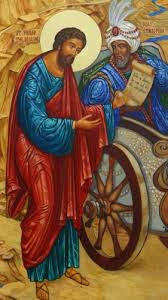
Commemoration of Philip the Deacon


Today we remember and give thanks for Philip the Deacon.  Philip, also called the Evangelist  (Acts 21:8), was one of the seven men appointed to assist in the work of the twelve Apostles and of the rapidly growing early church by overseeing the distribution of food to the poor (6:1–6). Following the martyrdom of Stephen, Philip proclaimed the Gospel in Samaria and led Simon the Sorcerer to become a believer in Christ (8:4–13). He was also instrumental in bringing about the conversion of the Ethiopian eunuch (8:26–39), through whom Philip became indirectly responsible for bringing the Good News of Jesus to the people on the continent of Africa. In the town of Caesarea he was host for several days to the Apostle Paul, who stopped there on his last journey to Jerusalem (21:8–15).

Collect of the Day:

Almighty and everlasting God, we give thanks to You for Your servant Philip the Deacon.  You called him to preach the Gospel to the peoples of Samaria and Ethiopia.  Raise up in this and every land messengers of Your kingdom, that Your Church may proclaim the immeasurable riches of our Savior, Jesus Christ, who lives and reigns with You and the Holy Spirit, now and forever.


(Treasury of Daily Prayer, pg. 804)


Sunday, October 9, 2022

Sermon for the Seventeenth Sunday after Trinity - Lk 14:1-11


Trinity 17

                                                                                       Lk 14:1-11

                                                                                      10/9/22


          Meals were viewed very differently in the ancient world than they are today.  First, the very act of choosing to eat with someone – to share in a meal with them - was an act of social significance.  IT indicated you accepted that person.  You considered them worthy to be in your presence and that you were willing to interact with them.

          Yet the fact people shared in a meal together did not in any way mean that everyone there was considered equal.  The ancient world had a highly developed sense of social honor and ranking.  And this fact was demonstrated in the way that people were seated.  Those sitting closest to the host were accorded the most honor – they mattered the most.  The farther away from the host you were seated, the less important you were.  Certainly, no one wanted to be seated in the last place at the table!

          And while it sounds almost comical to us, this led to a competition to see who could get a higher place in the seating. This fact was widely recognized by all.  You hear it in our Old Testament reading from Proverbs where the advice is given: “Do not put yourself forward in the king's presence or stand in the place of the great, for it is better to be told, ‘Come up here,’ than to be put lower in the presence of a noble.”

          Everybody understood that this is how things worked. The early second century Platonic philosopher Plutarch criticized the practice as he wrote: “When we have taken our places … we ought not to try to discover who has been placed above us, but rather how we may be thoroughly agreeable to those placed with us … For, in every case, a man that objects to his place at the table is objecting to his neighbor rather than to his host, and he makes himself hateful to both.” I bet you weren’t expecting to hear from Plutarch in the sermon this morning – but there you go. That’s exactly how things worked.

          Now in the Gospels – and it is especially emphasized in Luke’s Gospel – we find a very odd dynamic at work.  On the one hand the Pharisees were the enemies of Jesus. They were completely opposed to him.  And on the other hand, again and again they were hosting Jesus at their meals. So, our text this morning begins with the words: “One Sabbath, when he went to dine at the house of a ruler of the Pharisees, they were watching him carefully.”

          Here a leader of the Pharisees is hosting Jesus at a meal.  Why would he and the Pharisees do this?  There were surely two reasons.  First, Jesus was a religious celebrity.  Here was an individual who worked miracles and whose teaching captivated thousands.  Having Jesus eat at your table made you look good.

          And second, this was clearly an example of “keep your friends close, and your enemies closer.” As we hear, they were watching Jesus carefully.  These meals were an opportunity to hear Jesus say something that could be used against him.

          However, we learn in our text that Jesus was also watching the Pharisees.  He noticed how they were seeking the places of honor – how they were acting in the way that people normally did at meal settings such as this. And so we learn that Jesus told a parable to those who had been invited and were engaged in this behavior. Now when we hear the word “parable,” we expect to hear a story.  However, the term had a much broader meaning than that in first century Judaism, and so what Jesus gives is a piece of advice that is illustrated by a description of what happens.

          Jesus said, “When you are invited by someone to a wedding feast, do not sit down in a place of honor, lest someone more distinguished than you be invited by him, and he who invited you both will come and say to you, ‘Give your place to this person,’ and then you will begin with shame to take the lowest place.”  The opposite of honor was shame. The ancient world operated on the basis of these categories.   A person sought honor in the sight of others, and avoided shame in every way possible.

          Our Lord warned against seeking the place of honor, because doing so could result in shame.  Instead, he gave the instruction, “But when you are invited, go and sit in the lowest place, so that when your host comes he may say to you, ‘Friend, move up higher.’ Then you will be honored in the presence of all who sit at table with you.”  Note that Jesus doesn’t say, “Take a lower place.”  His advice is not that a person try to gauge his honor, and choose a lower spot in the hopes that then he will be invited to move up.  Instead, he says “sit in the lowest place,” or more literally, “sit in the last place.”

Then Jesus added, “For everyone who exalts himself will be humbled, and he who humbles himself will be exalted.”  It is in this statement that we begin to recognize that Jesus is not really talking about meal etiquette.  Instead, he is speaking about how life is lived in the kingdom of God. He is talking about how life that has received God’s saving reign acts.

Jesus says this because he brought God’s saving reign by humbling himself.  St. Paul put it this way when he told the Philippians, Have this mind among yourselves, which is yours in Christ Jesus, who, though he was in the form of God, did not count equality with God a thing to be grasped, but made himself nothing, taking the form of a servant, being born in the likeness of men. And being found in human form, he humbled himself by becoming obedient to the point of death, even death on a cross.”

The Son of God entered into this world in the incarnation as the Word became flesh. But this was not the humbling, for God himself had declared humanity to be very good in the beginning.  Instead, the humbling was that Jesus Christ did not use his powers to serve himself.  The humbling was the fact that he took on the role of a servant, the suffering Servant whom Isaiah had prophesied.  He humbled himself to the point of death – even the shameful death of death on the cross.

Paul says that our Lord Jesus was obedient to the point of death.  The Son of God was obedient to the Father’s will.  Isaiah said about the Servant, “But he was wounded for our transgressions; he was crushed for our iniquities; upon him was the chastisement that brought us peace, and with his stripes we are healed. All we like sheep have gone astray; we have turned--every one--to his own way; and the LORD has laid on him the iniquity of us all.” By humbling himself to the point of the shameful death on the cross, Christ has freed us from sin and made us holy before God.

The Son of God humbled himself. But in our text today he also says, “and he who humbles himself will be exalted.”  The apostle Paul went on to tell the Philippians, Therefore God has highly exalted him and bestowed on him the name that is above every name, so that at the name of Jesus every knee should bow, in heaven and on earth and under the earth, and every tongue confess that Jesus Christ is Lord, to the glory of God the Father.”

The Father exalted Jesus when he raised him from the dead on the third day.  The humiliation of the cross was not the final word. The sealed tomb was not the final word.  Instead, God’s saving word sounded forth as the risen Lord appeared in the locked room on the evening of Easter and said, “Peace to you!”

Nor was the resurrection the end of God’s exalting work.  Forty days after he rose from the dead, Jesus ascended into heaven.  Fifty days later, after the Holy Spirit had come upon the disciples at Pentecost, Peter told the crowd, “This Jesus God raised up, and of that we all are witnesses. Being therefore exalted at the right hand of God, and having received from the Father the promise of the Holy Spirit, he has poured out this that you yourselves are seeing and hearing.”

Jesus humbled himself, and then was exalted as he defeated death.  Because he has done this, we can now face our sin and confess it in humble repentance.  We can do so knowing that we will be exalted in forgiveness.  As Jesus said about the repentant tax collector in comparison to the self-righteous Pharisee: “I tell you, this man went down to his house justified, rather than the other. For everyone who exalts himself will be humbled, but the one who humbles himself will be exalted.”

The first century Greco-Roman world considered humility to be vice, rather than a virtue.  Perhaps it would be going too far to say that our world feels the same way. But you wouldn’t be off by much.  Our world glorifies those who exalt themselves in sports, entertainment, and so many other areas of life. Humility is not something that our world holds up as a characteristic that should be fostered and emulated.

However, as we see in Christ, God’s way is different.  Mary said about God, “He has shown strength with his arm; he has scattered the proud in the thoughts of their hearts; he has brought down the mighty from their thrones and exalted those of humble estate.”  In our text Jesus says, “For everyone who exalts himself will be humbled, and he who humbles himself will be exalted.”

This is what Jesus Christ did for us in order to give us forgiveness, salvation, and eternal life.  The risen and exalted Lord has given us the Holy Spirit who has called us to faith. Through baptism we have become a new creation in Christ. Born again of water and the Spirit, the new man now seeks to follow in the way of our Lord.

We humble ourselves in service toward others, just as Christ humbled himself to serve and save us. We put the needs of our spouse, children, parents, and friends ahead of our own.  We serve and help others in the different vocations where God has placed us.  In doing so, we become the means by which God acts to care for those whom he has placed in our life.

Led and enabled by the Spirit, we do this because we believe in Jesus Christ.  We humble ourselves, confident that in Christ the way of humility leads to exaltation.  He humbled himself to the point of death – even death on a cross – in order to save us. But on the third day God raised him from the dead, and then the Father exalted Christ in his ascension.  Because of this, we know that the way of faith – the way of humble service in Christ - leads to resurrection life with our Lord. As Christ says today, “For everyone who exalts himself will be humbled, and he who humbles himself will be exalted.”


Sunday, October 2, 2022

Sermon for the Sixteenth Sunday after Trinity - Lk 7:11-17


Trinity 16

                                                                                       Lk 7:11-17

                                                                                      10/2/22


          At the beginning of this year, I took part in the funeral procession for Good Shepherd member Dale Krack.  It was an experience unlike anything I had seen before. Dale had just recently retired from his career as an Illinios State Trooper. He had also served in the Army National Guard, and had been deployed overseas on several occasions.

          The Krack family had moved to this area from Red Bud fairly recently.  Most of their family and friends were back in that area, and there was no way that our church building could accommodate the funeral. It therefore made good sense for the funeral to take place at St. John’s, Red Bud, their prior congregation.

          The first thing I saw as the procession began was how people from Red Bud had gathered outside holding American flags all along the route of the funeral procession.  The burial was going to take place at Jefferson Barracks National Cemetery. During the drive there, the hearse was flanked by State Troopers on motorcycles.  As the funeral procession made its way to the cemetery – every single highway onramp; every single street crossing on the entire route - was blocked off by some type of police unit.  But it was only once we arrived at the cemetery and I saw the rest of the funeral procession pull up, that I realized there were about fifty State Trooper vehicles in the procession. It was incredible.

          The funeral procession bore witness to the respect and admiration that people had for Dale.  You saw it in the response by the people in Red Bud.  Certainly, there is unique bond among those in law enforcement. But the scale of participation went beyond that fact.  In talking with others, it was clear that Dale was highly respected by his fellow State Troopers and that the level of participation bore witness to this.

          In our Gospel lesson this morning we hear about another funeral procession.  Luke describes it in a way that also calls attention to its notable character. Jesus works a miracle as he raises from the dead the young man who is being carried out for burial.  In this miracle, we see that God has visited us to bring us salvation.  And in what follows, we also gain insight into how we are to view the tragedies and hardships that we encounter in this world.

          We learn in our text that Jesus, his disciples, and a great crowd that accompanied him arrived at the town of Nain.  As they drew near to the gate of the town, they were met by another group that was coming out.  We learn: “behold, a man who had died was being carried out, the only son of his mother, and she was a widow, and a considerable crowd from the town was with her.” 

          Luke calls attention to the size of the funeral procession.  Clearly, it made an impression.  In this case the notable character of the procession had been caused by circumstances of the mother.  She was a widow, but she had a son who was a young man.  Unlike the widow that we heard about in last week’s sermon, she did have someone who could begin to help support her.  However now this son – her only son – had died.  Her husband had died.  Her only son had died. She had no one, and the community was clearly moved by her terrible circumstances.

          We learn that when Jesus saw her, he had compassion on her. This teaches us about the character of our Lord.  He sees suffering and has compassion – he cares deeply.  We need to recognize the truth that this is the same way that he views us as we experience suffering and hardship in life.

          Now when we learn about suffering, we often have compassion.  We probably do what we can to comfort and support those involved. But that is all we can do.  The Lord Jesus is different, and we see this in our text because first he does something shocking, and then he performs a miracle.

          Actually, our Lord does two shocking things. First, he said to the woman, “Do not weep.”  Who tells a grieving mother at her only son’s funeral not to cry? Then Jesus stopped the funeral procession as he came up and touched funeral bier on which the body was being carried. Who interrupts a funeral procession?  And then on top of this, the act of touching the bier meant ritual uncleanness according to the Old Testament law.

          Yet Jesus was acting to perform a miracle. We learn: “And he said, ‘Young man, I say to you, arise.’ And the dead man sat up and began to speak, and Jesus gave him to his mother.” Jesus raised the young man from the dead.

          Understandably, fear seized all who saw it. They glorified God saying, “A great prophet has arisen among us!” and “God has visited his people!”  We spoke last Sunday about how Jesus is the final end time prophet.  So this morning, I want to focus on the second statement by the crowd: “God has visited his people!”

          In the Jesus Christ, God has visited his people. When Zechariah spoke words caused by the Holy Spirit after the naming of John the Baptist he said, Blessed be the Lord God of Israel, for he has visited and redeemed his people and has raised up a horn of salvation for us in the house of his servant David, as he spoke by the mouth of his holy prophets from of old, that we should be saved from our enemies and from the hand of all who hate us; to show the mercy promised to our fathers and to remember his holy covenant, the oath that he swore to our father Abraham.”  In Jesus, God did visit his people as he fulfilled the promises made to King David and to Abraham. And of course, part of God’s promise to Abraham was that in his offspring, all nations would be blessed – we would be blessed.

          When Jesus was at the synagogue in Nazareth, he read this passage from Isaiah and declared that it was fulfilled in him: “The Spirit of the Lord is upon me, because he has anointed me to proclaim good news to the poor. He has sent me to proclaim liberty to the captives and recovering of sight to the blind, to set at liberty those who are oppressed, to proclaim the year of the Lord's favor.”

          Jesus Christ didn’t just proclaim good news.  He was the good news.  He was the Son of God in this world, conceived by the Holy Spirit and born of the virgin Mary. He was God visiting his people in order to bring freedom from sin, death, and the devil.  The miracles that he performed all pointed towards the single great act by which he would accomplish this. 

          Luke tells us in chapter nine, “When the days drew near for him to be taken up, he set his face to go to Jerusalem.”  Earlier in that chapter he had told the apostles, “The Son of Man must suffer many things and be rejected by the elders and chief priests and scribes, and be killed, and on the third day be raised.”

          Jesus Christ, the incarnate Son of God, was in this world to suffer and die. He was here to suffer and die to redeem us – to free us from sin.  He was here to take our sins as if they were his own, and receive God’s wrath and judgment in our place.  Jesus hung on the cross in the darkness of Good Friday as he suffered and died for us.

          In our text we see that Jesus confronts death.  The Lord Jesus died on the cross in order to provide the final answer to death. Dead and buried, on the third day God raised him from the dead. The tomb was empty and the angels announced to the women, “Why do you seek the living among the dead? He is not here, but has risen. Remember how he told you, while he was still in Galilee, that the Son of Man must be delivered into the hands of sinful men and be crucified and on the third day rise.”  By his resurrection, Christ has defeated death. We have eternal life already now. To die is to be with Christ, and the Lord will return in glory on the Last Day to raise our bodies from the dead, and transform them to be like his own.

          This is true. But that still leaves us with a question that is impossible to avoid: What about right now? As I will announce in the Prayer of the Church today, what about the Lutheran pastor in our area whose teenage son died this week? What about all of the people for whom we pray in the Prayer of the Church – those suffering from cancer and many other physical hardships?

          Immediately after our text, we hear about how John the Baptist was in prison. John – the fulfilment of God’s prophecies – had proclaimed God’s word about the imminent arrival of God’s reign, and King Herod Antipas had imprisoned him because he had rebuked Antipas’ sin. This wasn’t how things were supposed to be. And so from prison John sent two of his disciples with this question: “Are you the one who is to come, or shall we look for another?”

          Jesus answered in this way: “Go and tell John what you have seen and heard: the blind receive their sight, the lame walk, lepers are cleansed, and the deaf hear, the dead are raised up, the poor have good news preached to them. And blessed is the one who is not offended by me.”  Jesus told John that, yes, he was the One. After all, he had just raised the widow’s son from the dead!

          But to John who sat in prison, and would soon be martyred, our Lord also said, “And blessed is the one who is not offended by me.”  Jesus Christ did not win our salvation in a way that looked glorious and powerful to the world.  Instead, he did it in the way of the cross.  This is not the way John wanted things done.  It is not the way we want things done.

          The life of the Christian is not one grand victory after another.  It is a life lived in what remains a fallen world as we continue our struggle against the old Adam.  It is a life in which there are tragedies that we cannot understand.  It is a life lived in the midst of suffering and hardships.

          But it is also a life in which we have already seen God’s great answer.  We have seen it in the death and resurrection of Jesus Christ.  God has revealed his love for us as he sent his Son to die in our place.  Christ has revealed his love as he obeyed the Fathers’ will by suffering and dying on the cross to win forgiveness for us.

          Yet God’s answer did not end in death.  Instead, it led to the resurrection of Jesus.  It led to the defeat of death that has already occurred in the risen Lord. And because of this we have hope.  The apostle Peter wrote, “Blessed be the God and Father of our Lord Jesus Christ! According to his great mercy, he has caused us to be born again to a living hope through the resurrection of Jesus Christ from the dead.”

          And so we live by faith in Jesus Christ, who is the crucified and risen Lord.  He is God’s answer in the midst of all the things we don’t understand.  He is God’s comfort in the midst of tragedy and suffering.  The Spirit of God who raised Jesus from the dead is the One who called us to this faith and sustains us in it.  Nourished by Christ’s Means of Grace we too say, “God has visited his people!” even as we live in confidence that he will visit us one final time on the Last Day – the day when we will no longer walk by faith but instead by sight as we live with our Lord in the new creation forever.